Showing posts with label parents. Show all posts

Sunday, March 3, 2024

searchin'

This story appeared on my illustration blog twelve years ago, complete with a drawing of my father. It's a funny story that wasn't too funny while it was actually happening.
I'm pretty sure my dad's intentions were good, but he had his own quirky method of making them known.

My father followed an old-time, though slightly skewed, set of ethics. He was a hard worker and blindly devoted to the company he worked for — no matter how little that company gave a shit about him. He tried to instill his work ethic into my brother and me and he somewhat succeeded, as we are both hard workers. However, the Pincus boys just never bought into the "blind loyalty" part, as we came to know after years of working for various employers, that most employers feel that their employees are expendable and easily replaced.

My father loved his family and his way of showing love was to keep constant tabs on their schedules and their whereabouts. As my brother and I came into our teens, that task proved increasingly difficult for my father. Where are you going? How long are you staying there? When will you be home? Who will you be with? these were all part of the regular barrage of questions my brother and I were riddled with when we made a motion toward the front door during our adolescent years. My older brother's teenage antics made a wreck of my father's sense of family order and when I reached "driver's license" age I was no better.

In the summer of 1980, when I was 19, I ran a sidewalk produce stand for my cousin at 16th and Spring Garden Street in downtown Philadelphia. My cousin awakened in the wee hours of the morning and would spend several hours purchasing stock for the stand at the massive Food Distribution Center in South Philadelphia. He'd load his van with crates of fresh fruit and vegetables and I'd meet him at the stand around 8 a.m. to help unload the van and set up for the day. I did this every weekday for the entire summer and, even though I would sometimes stay out fairly late on weekday evenings, I was never on that corner later that 8 a.m. the next day. No matter what. Never.

At the beginning of that summer, I went on my first vacation without my parents. I went to Florida with three of my friends. When I returned home, my cousin recruited me to hawk plums and lettuce and I was just getting into the daily routine that the job required. I had also just met a girl at a local record store and we made plans for a date. Late one afternoon, I came home tired from a full morning of weighing out cherries, bagging bananas and persuading passers-by to pick up some tasty spuds for their family's dinner. After a shower and a change of clothes, I was ready to take this new girl out to a restaurant and who-knows-what-else. I met my father on the front lawn as I was leaving the house and he was arriving home from work. Right on schedule, the questions began.

He opened with his old favorite — "Where are you going?"

"I have a date."

"When will you be home?"

"I don't know. Later, I guess."

"You know, you have work tomorrow.," he informed me, as though I would not have otherwise been aware of my employment.

"I know.," I answered as I opened the driver's door of my mom's car and slid behind the wheel. My father stood on the lawn, arms folded across his chest, and watched me drive off. It was apparent that he was not pleased with my limited answers to his inquiries.

I arrived at Jill's house and offered her the passenger's seat in my mom's tank-like Ford Galaxie. We chatted as we drove and at one point I glanced in her direction as she nonchalantly popped a Quaalude into her mouth. We pulled into the parking lot of the Inn Flight Steakhouse on Street Road and I helped Jill through the entrance doors as her self-medication affected her navigational ability on the short walk from my car. At dinner we talked and joked and exchanged other typical "first date" pleasantries. Before we knew it, we had spent several extended hours at that table, although I'm sure I was more aware of the time than she was. (Under the circumstances, I sure I was more aware of a lot of things than she was.) She invited me back to her house, explaining that her parents were away for a few days (hint, hint). We drove to her house and, once inside,  she motioned to the basement, telling me she join me in a few minutes.

Meanwhile, my father was manning his usual post at the front door. He stood and stared out through the screen with an omnipresent cigarette in one hand, checking his watch approximately every eight seconds.

"Where the hell is he?," he questioned my mother.

"He's on a date. He told you. You saw him when you came home from work.," she replied, as she had countless times before.

"He has to go to work early tomorrow morning. Doesn't he have a watch? Doesn't he know what time it is?" My father was convinced that if he personally didn't inform you of the current time, you couldn't possibly know. He fancied himself humanity's "Official Timekeeper". He would have made a great town crier.

My mother — that poor exasperated, sleep-deprived woman — tried to reason with my father. "He'll be home. He knows he has to work. He's responsible. You know  he's responsible."

Suddenly, he grabbed his coat and scanned the living room for his car keys. "What are you doing?," my mother asked, suspiciously.

"I'm gonna go look for him. Maybe he has a flat tire.," he said, trying to sound concerned, but my mom was not convinced.

"You don't even know where he is. You don't know where the girl lives. You don't even know her name! Where are you going to look?" My mother knew he was up to something. No one could get anything  past my mother. Especially my father.

"Then, I'll drive around and look for him." Ignoring her words, my dad got into his car, backed down the driveway and sped off to a planned destination. He had no intention off driving around. He knew exactly where he was going. Somewhere around the time that Jill was descending her parent's basement steps wearing little more than a blanket and a smile, my dad was bursting through the doors of a police station several blocks from our home.

"My son is missing.," my frantic father shouted at the policeman on duty, "I don't know where he is!"

The unfazed officer grabbed a pen and, with it poised above a notepad, asked my father, "When did you see him last?"

"About seven hours ago," my dad replied, "when he left for a date."

The policeman dropped the pen, cocked one eyebrow and stared blankly at my father. "He's probably still on the date, sir." He instructed my dad to go home, assuring him that I'd probably be home any minute. Annoyed and dejected, my father shuffled back to his car and drove home. A few minutes after he pulled into the driveway, I steered my mom's car along the curb in front of my house. As I walked up the front lawn, searching for my house key, the front door opened and the shape of my father was silhouetted by the living room lamp. My mother was lurking several feet behind him.

"What are you still doing up?," I asked.

"Where the hell were you?," my father yelled, "I just came from the police station looking for you."

With this information coming to light for the first time, my mother and I simultaneously emitted a loud, angry and incredulous 'WHAT?'

"You went WHERE?,"  I screamed, "You knew I was on a date! Are you INSANE?"  I glanced down at my watch (contrary to my father's beliefs, I did own one and I referred to it often). "I don't have time to talk about this. I have to wake up in a couple of hours to go to work." I echoed my father's ingrained work ethic and looked him square in the face. "And so do you.," I finished.

With that, I stomped upstairs, flopped down on my bed and drifted off to sleep to the muffled tones of my mother's reprimanding voice coming from my parent's bedroom below.

I know my father's main concern was my safety and well-being and his intentions were honorable, but he desperately needed to take a course in Parental Behavior. Lucky for him, I think my mom taught those classes.

www.joshpincusiscrying.com

Sunday, December 3, 2023

get it right the first time

I recently wrote a story about an age-old incident that has been lingering over my family for years… actually decades. The details of the story – as I recall – have been hotly debated by my brother and me. Since we are the two survivors of the story in question, that debate shows no signs of being resolved. The other two main characters in the story – my mother and my father – have since passed away, so, in the waning years, this tale has been reduced to a “he said-he said” among siblings. Not wanting to stir up an argument with my brother, I have been very careful not to bring up this incident in his presence, as my version of the story differs greatly from his. So, I have told my take to my family over the years and – with no other account for reference – that’s the version they have come to know and believe. I published this story on It’s Been a Slice, with the comforting understanding that my brother never reads my blog. He has better, more productive, things to do than read about my antics in cemeteries and my overblown analysis of The Partridge Family. Knowing that my brother wouldn’t see my “official” published narrative of the notorious Pincus Family “cake-dropping” incident, I was free to make my version the version among the handful of followers who read (and inexplicably look forward to) my posts every Sunday morning. 

I was wrong. And it turns out, I was wrong about a lot of things. 

The pre-disagreement
Pincus Boys
My brother Max, four years my senior, has been enjoying the life of a retiree. He goes to the gym. He reads. He plays card with other retirees. And every once in a while, he casually peruses Facebook. Last Sunday, while wading through the political posts, speculation on the Eagles’ chances of taking the Super Bowl and notifications of the birthday of a long-forgotten co-worker, my brother came upon a photograph that piqued his interest. It was the stock image of a smashed cake that I used to accompany my story of the afore-mentioned incident. Seeing my name associated with the picture, he figured I must have written about "the incident." 

So, with plenty of time on his hands, my brother clicked on the link, arrived at my blog and read my most recent entry. 

I don’t think he was
angry. I think he was more confused, if anything. You see, he never thought there was any sort of disagreement over how the events played out. As far as he knew, the story happened one way – the way he remembered it. He never knew that I had a completely different memory of the incident and that I had been telling my version for years. 

Well, Max was about to take matters into his own hands and set the record – and his brother – straight. 

As the time stamp confirms, I published the post on my blog bright and early on Sunday morning. 5:00 o’clock AM, to be exact. Somewhere around lunchtime, I received an alert that a comment had been left on my blog by one “Max Pincus.” I held my breath and thought: “I can’t believe he read my blog. He never reads my blog!” Admittedly, there were a few stray butterflies doing loop-de-loops in my stomach as I began to read my brother’s rebuttal. 

Here is Max’s statement. Read along with me… 
Your blog certainly is amusing. Unfortunately, it also happens to be inaccurate. Here is what actually happened... 

I was asked to pick up a birthday cake, although I do not recall whose birthday was being celebrated. Once I got the cake, I returned home in my white 1963 Buick LeSabre, which cost me $325 and got about eight miles per gallon. As always, I parked on the street directly in front of the house. I got out of the car with the cake, took a few steps and somehow dropped the damn cake in the street. 

My mother -- NOT my father -- saw me park the car in from the of house and was on her way outside to greet me. When she saw what I had done, she pretty much lost her mind. She bounded across the lawn to confront me and began screaming -- in a loud enough voice to attract the attention of several neighbors (who gladly will confirm my version of the story) -- "How do you drop a cake? How is that possible that you dropped the cake?" She bent down and picked up the smushed cake out of the street, then began pushing it into my arms, all the while yelling, "Show me how you drop a cake. I wanna see how you dropped the cake." As I made my way into the house, Mom was following close behind, loudly requesting a demonstration of how I managed to drop the cake. 

Fortunately, for the sake of everyone's sanity, my mother was laughing about the incident before she went to sleep that night.

One final note: The notion that my father, who I do not recall being present when I lost my grip on the cake, "knelt down and awkwardly gathered up the cake box in his hands" is absurd. I never saw him clean up a mess of any kind, regardless of the circumstances. Ever. 
I’ll tell you this. He makes a darn good argument. Darn good! With the finesse of a seasoned attorney (he is not), Max presents a detailed description, complete with specific bits of information and precise chronology. He even cites possible witnesses who could corroborate his story if, say, this thing went to trial. Honestly, if it did go to trial, I might be brought up on charges of perjury. 

We agree that a birthday cake was purchased, although neither of us recall who was the honoree. We also agree that said cake was indeed dropped and that Max was indeed the party responsible for the cake’s unfortunate date with gravity. After that, our stories split and split wildly. 

I will say, however, that Max’s story does make a lot of sense. I can absolutely envision my mother’s behavior as my brother describes – at first furious and then jovial as time pacified her anger. I also wholeheartedly agree that my father would never ever make any sort of attempt at cleaning anything up. Ever. That was women’s’ work and it would cut into his cigarette smoking time. Max also elaborated on the subsequent reaction of a neighbor. I could picture that happening, too. 

One of my mother’s favorite adages was: “The six most important words you could ever say were – I admit I made a mistake.” My mother was a very smart person. I will happily – and humbly – repeat those words with respect to my brother. 

Hey, I'm sure I’ve been right about other things. I guess.

Sunday, October 22, 2023

happy loving couples

My parents had a group of friends with which they socialized on a fairly regular basis. By "regular basis," I mean whenever my mother made plans with the wife of the couple. Then, those plans were gently divulged to my father upon his return from a "hard day at work." (Every day at work was a hard day at work for my father.) My father would, of course, frown and grumble and express his displeasure at the thought of getting together with "those couples." Then he would relent when my mother would glare and threaten to withhold dinner beyond the unspoken but pre-determined 6:15 start time. You see, the majority of my parents' "couple friends" were my mother's friends from her days as a carefree, slightly uninhibited "party girl" and their husbands. I honestly don't remember any of the storied men from my father's youth making it to the "married adult friends list." 

My mom kept in close touch with her teenage (and beyond) girlfriends. She attended each of their weddings as a still-swinging single. When she became a bride at the unheard-of age of 33, her now-married friends joined her and rallied around to watch the once spontaneous and unpredictably wild Doris become Mrs. Pincus the First. Keeping in step with 1950s society expectations, my mom made regular plans with her friends and their husbands — regardless of how my father felt.

My mom had three very close friends in their early twenties — Annette, Roberta and Bernadette. These three women, led by my mom, would descend upon various Catskill, New York resorts (like the one you saw in Dirty Dancing) and — as they say — "paint the town red." They would swim and dance and drink and flirt and flirt and flirt. My mom was the ringleader of the "Four Musketeers" and her friends were only too happy to follow along. Marriage, however, calmed these ladies down — reducing their frenzied nights of debauchery to quiet games of Mah Jongg. But, my mom liked having friends and, even though my father didn't like having friends, she got together with her friends and forced my father to be as cordial as he possibly could.

Plans were made most often with my mom's friend Annette and her husband Rusty. Annette was a typical quiet, polite, reserved 60s housewife, behaving as though she stepped right out of a TV family sitcom. Rusty was loud and boisterous and wore bold plaid sport jackets and told corny jokes. And, according to my father and repeated regularly, Rusty was cheap. Maybe that's the reason my father never wanted to get together with Annette and Rusty. My father, one of the world's worst handlers of money, had a terrible habit of reaching for the check at the end of a restaurant meal with friends. Always wanting to appear "the big shot," my father would grab the check as soon as the waiter would drop it on the table. Other husbands would protest and argue with my dad that the check should be split — the reaction my father was always hoping for. But not Rusty. Rusty would shrug and loudly exclaim to his wife: "Look Annette! He's doing it again!" Rusty would never argue or reach for his wallet, but he always had the same reaction. And my father still continued to grab the check first. He never learned.

One time, my mom made plans to go to a baseball game at brand new Veterans Stadium, the giant concrete monstrosity in South Philadelphia that was the new home to the Philadelphia Phillies after the closing of the venerable Connie Mack Stadium in North Philly. My father often took my older brother to Phillies games at Connie Mack, leaving my mother and I to stay home and listen to the game on the radio. My mom's plans for a family outing at the ballpark would include Annette and Rusty and their daughter, Cindy Wanda, who was my age. I didn't especially like Cindy Wanda (and I think the feeling was mutual), but a friendship was forced upon us by our parents. And I always thought it was weird that she was always referred to by her first and middle names. As per usual, my father grumbled about plans with Annette and Rusty, but, as per usual, buckled under pressure from my mother. Tickets were bought and we were going.

The day of the game — a Sunday afternoon — we found our seats and settled in. Somewhere around the third inning, my father silently rose and left his seat, never informing anyone of his destination. A few minutes after my father left, Rusty also left and scurried up the aisle of our section. Rusty returned quickly, carrying three hot dogs in his hands. He made his way to our seats and handed a dog to his wife and his daughter and they ate in silence. My father soon appeared toting six hot dogs — one each for his family and for his "friends' family." He was visibly angered by the fact that Rusty and his family where already munching on their own ballpark staples. He grew more vexed when Rusty happily accepted three more hot dogs and opined a familiar sentiment: "Look Annette! He's doing it again!" 

Every so often, my mom would invite her friends and their husbands to our house for an evening of talk, camaraderie and some games — poker for the men in one room and Mah Jongg for the ladies in another room. With the notion of company, my mom would stock up on snacks and such, putting out a spread on our kitchen table of cold cuts, bagels, sandwich accoutrements and condiments, as well as big bowls of potato chips, pretzels and something called "bridge mix," little dark chocolate coated morsels that resembled rabbit droppings. Often these little get-togethers would rotate from house to house and a similar array of food and refreshments would be offered by the evening's host couple. My father dreaded when Annette and Rusty where the "hosts of the week." (Honestly, my father dreaded these evenings PERIOD.) The food at Annette and Rusty's was minimal, consisting of cheese slices and other foodstuffs corresponding to the exact number of people attending the night's gathering. Four couples? Eight slices of cheese. No more. No less. Eight bagels. Eight slices of tomato. Eight napkins. You get the picture. Oh, and eight cans of soda were set out. And no ice bucket.

After a while, my parents didn't get together with my mom's friends and their husbands. My mom began working full time and taking on lots of overtime hours. Her time at home was spent catching up on sleep. My dad was just as happy. he went to work. He came home. He smoked a ton of cigarettes, ate a lot of red meat and watched a lot of television. Friends he didn't need or want.

Especially cheap ones.

Sunday, January 30, 2022

I've got gadgets and gizmos a-plenty

Kitschy appliances were all the rage in the 60s and 70s. And my mom had her fair share of them. Sure, she used her trusty electric skillet most often. She'd make her own spaghetti sauce and would brown a pound or so of ground meat in her electric skillet before adding it to the sauce. She used her electric skillet to make hamburgers, fry chicken and, at Passover, she'd use it to make matzo brie (fried matzo), one of the few things I like about the springtime Jewish holiday. The electric skillet was always out, always on display on the counter of our avocado-colored kitchen, because it saw so much regular cooking action.

My mom had a pressure cooker, too, and that also got plenty of use in the Pincus kitchen. At least once a week, my mom would stuff that pressure cooker with little cubes of beef, cut-up vegetables and homemade dumplings. Then, she'd clamp the lid down tight and, several hours later, she would extract the most delicious beef stew you or I ever tasted (of course, this is a biased opinion).

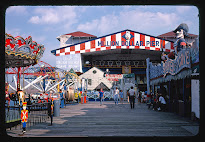
But, aside from those two cooking aids, our kitchen boasted a number of appliances that got very infrequent employ, some just a single use. A lot of these appliances were obtained at our favorite appliance outlet — Million Dollar Pier on the famous Atlantic City Boardwalk. For those of you familiar with Atlantic City in its 1960s heyday, you are probably wracking your brain to try to remember an appliance store among the rides, food stands and sideshow performances. Well, there wasn't one, so you can stop. I am, of course, referring to the various Wheels of Chance that encircled the perimeter of the amusement pier, as well as those that dotted the actual Boardwalk. These games involved a giant wheel with at least a zillion individual spots delineated by metal pegs. After placing a nickel (later a dime, and then even later, a quarter) on a corresponding spot on the counter of the stall, the game operator would give the oversized arrow in the middle of the wheel a big spin. The excitement would build as the blurred arrow whizzed around and around until it slowed and eventually stopped — where its rubber pointer would indicate the winner for that round. I was always given the opportunity to choose which lucky spot would hold our coin for a particular round of the game. Would I choose a color or a number or one of the  many choices of three letter names like "ART" or "BOB" or "MOM?" Aside from the excitement the wheel generated, the stand itself was a spectacle. The rear shelved section of each of these booths was jam-packed with brand-new, in-the-box, brand name appliances punctuated with large, brightly-colored signs that read: "EASY TO WIN!" and "YOUR CHOICE!" In reality, it wasn't easy to win and my parents would often spend too much time and too much money trying to win an unnecessary appliance that would end up costing three times the price they would pay if they just went to our local discount department store. But where was the thrill in that? However, no trip to Atlantic City was complete without an extended encounter at one of the wheels. 

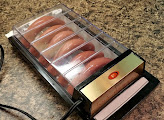
My mom won a Presto Hot Dogger one summer. TV chef Alton Brown cautions viewers to avoid "unitaskers" in the kitchen, referring to novelty cookware that serves just a single purpose. He says that every item in your kitchen should be able to perform a multitude of tasks — save for a fire extinguisher, the only "unitasker" he says is permissible. Well, the Presto Hot Dogger is the unitasker to top all unitaskers. This little device accommodated a half dozen standard size hot dogs and, once there were curved and placed in position, made the cumbersome, strenuous, time-consuming chore of cooking hot dogs a thing of the past. The hot dogs, held in place by impaling their little tips on two dangerously pointed (and wired-for-electricity) spikes, tasted like you'd imagine licking a newly-unplugged electric plug would taste. But, they were cooked in a fraction of the time — if you call that "cooking." No amount of ketchup, mustard, relish, onions or even sauerkraut could mask the unmistakable flavor of 110 volts of household current. But we ate them, because it was the 70s and that's how Madison Avenue told us we should be cooking hot dogs in the "modern age." After a few uses, the Presto Hot Dogger was relegated to the hall closet and my mom went back to filling a big pot with water and boiling hot dogs when they were requested for dinner.

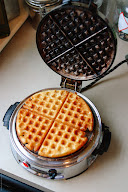
Another acquisition from the shelves at Million Dollar Pier was a waffle iron. My dad was most excited about this... probably because he didn't have to actually prepare the waffles. That was left to my mom. Every so often, my mom would surprise the family on a Sunday morning by making pancakes in her reliable ol' electric skillet. She could churn out those little golden beauties at an alarming rate, keeping my dad, my brother and me satisfied with an always-tall stack of hot cakes before each of us, often replenished before being asked. When we each had our fill, we'd vacate the kitchen table, leaving my mom to clean up and enjoy the last few pancakes by herself. But waffles.... that was a different story. That required an extra step, one my mom wasn't exactly thrilled with. She didn't mind making pancakes, but waffles... well, those were just square pancakes. The process of filling each little square reservoir with batter, closing the lid, watching a timer, gingerly removing the finish waffle without tearing... well, that was just... just.... stupid. Soon, my mom placed the waffle iron next to the hot dogger and the Pincuses went back to eating pancakes.

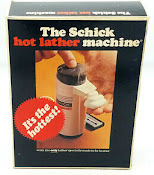
Useless appliances weren't just specific to the kitchen... or to my mom's exclusive usage. Nope! One day, my dad won a Schick Hot Lather Machine at Million Dollar Pier. That thing sat in a place of honor on the bathroom counter, next to a couple of bottle of my dad's after-shave and my mom's prized atomizer of Giorgio. The Schick Hot Lather Machine was loaded with a standard size can of ordinary shaving cream, but after plugging it in, it released a wad of slightly warmed cream, just like you'd get at your local barber shop.... as though my father ever let his barber shave his face. The Schick Hot Lather Machine lasted, in regular usage, for as long as it took to use up one single can of shaving cream. After that, my dad went back to shaving with cream straight from the can... and the Schick Hot Lather Machine joined its kitchen pals in the hall closet.

When my parents passed away in the early 1990s, cleaning out their house was quite an undertaking. Apparently, my parents never threw anything away. When the hall closet was opened, it was as though we were hovering behind Howard Carter as he entered King Tut's tomb. Fittingly, that closet looked like its contents had been touched since 1922. There was a long-forgotten collection of one-time used appliances that hadn't seen the light of day since the Nixon Administration.

A fire destroyed the then-closed Million Dollar Pier in 1981. So much for making a return.

Sunday, February 17, 2019

I know what I like

When I was a kid, going out to a restaurant was not that big of a deal because my family did it a lot. I'm not talking about an extravagant, fancy place that required my dad to wear a tie and my mom to call ahead and make a reservation. My family most frequently ate at the Heritage Diner, an unassuming establishment just outside the confines of my Northeast Philadelphia neighborhood. My father — a staunch traditionalist, very set in his ways — ate breakfast there most mornings and it was always the same. So much so, that the waitresses knew what to bring without even taking an order. Two scrambled eggs, toast and coffee. Never — I repeat never! — would his breakfast platter ever include "home fries," as the sight of potatoes in the morning made my father nauseous. Fifteen cigarettes before 7 AM were just fine, but potatoes.....

Besides my father's solo, potato-less breakfasts, my family would often have our dinner at the Heritage Diner. The Heritage had standard diner fare — a menu the size of a small novel and a two-sided, typewritten page of "Daily Dinner Specials" that included soup or salad, choice two vegetables, bread and butter, a beverage and a limited selection of desserts — all for one low price. (Or so I imagined. The price of dinner didn't matter to me. I was a kid, after all. My dad was picking up the check.)

Eating at The Heritage during the week, the unspoken rule was to order a hamburger or a tuna sandwich or maybe an omelette. The "Daily Dinner Specials" were reserved for weekends, specifically Sunday. We had Sunday dinners at The Heritage probably twice a month. Those were the times when we were permitted to order off the "Daily Dinner Specials" menu. I would scan the two sides of that poorly typed sheet, reading each and every entry — even the ones I had no intention of ever ordering... which was most of them. I was always intrigued when my mom — after reading those enticing offerings — would tell the waitress that she would like liver. In my little mind, I would think to myself: You can have anything you want! Why would you order liver in a restaurant? That's like punishment! Once, I actually asked my mom why she always gets liver. She smiled and explained that she loves liver, but no one else in the family does (not even my dad — who was a butcher by trade). So restaurants presented the only opportunity she had to get liver. And she didn't have to cook it! Made perfect sense — even if the end result was a plate of liver.

I, however, usually ordered one of two entrees — alternating on alternate Sundays. Sometimes I would get roasted turkey because it reminded me of Thanksgiving. It came with a salad, which I would automatically slide over to my mom just as the waitress set the plate in front of me. It also included a baked potato, which I would eat (except for the skin) and (at my mother's insistence) string beans, which I would stare at. Alongside the mound of sliced turkey drenched in that unnaturally-yellow gravy, was a small souffle cup containing a dollop of cranberry sauce, which I also never ate. My other "go to" dinner was fried flounder, which was essentially a giant fish stick. It, too, came with a second salad for my mother, a serving of French fries and a liquidy bowl of cole slaw which I stared at like it was a bowl of string beans. One time, I think I may have asked for, as my two side orders, French fries and a baked potato.

For me?
The choices of available vegetables that the Heritage offered to accompany their "Daily Dinner Specials" read like "Nixon's Hit List," if it was compiled by an eight-year old. String beans, broccoli, a mixture of broccoli and cauliflower, peas, carrots, a mixture of peas and carrots, a mixture of peas, carrots and string beans, apple sauce, creamed spinach, French fries or a baked potato. This was food for old people. I suppose that was the target audience for the "Daily Dinner Specials." I guess whoever decided what would go on the "Daily Dinner Specials" each day presumed that any children along for the ride would order from the special children's menu (with its entrees whimsically-named in honor of cartoon characters and storybook heroes, presented along with a 6-pack of crayons and a ready-to-be-colored place mat). They knew darn well that no kid was asking Mom if it was okay to order creamed spinach.

But a funny thing happened. I grew up. And I grew up to surprise myself.

Lately, I found myself actually ordering broccoli in a restaurant. Broccoli! Me! Little Josh Pincus! Imagine! I have done this more than once, too. I have ordered peas and carrots. I have ordered cole slaw. I have even ordered string beans and eaten them. I honestly can't believe that so many foods I shunned as a child have become some of my favorites. I don't even pick the lettuce off of my (veggie) burger! Me! And I'll eat the skin from a baked potato. My mom was right! It is the best part.

I became a vegetarian in 2006. (Not a vegan, a vegetarian. If I was a vegan, you'd know it. Every blog post would be about me being a vegan.) Since then, I have eaten more vegetables than I ever had in my entire life. I've even become more adventurous, venturing out into the world of succotash, asparagus, Brussels sprouts, Harvard beets, artichokes.... and enjoying every one of them. Okay, maybe not Brussels sprouts so much. Because I am a vegetarian, I won't order liver in a restaurant, but, I no longer pass the salad off to someone else.

My mom would be proud.

Sunday, February 3, 2019

leave those kids alone

My ten-year old nephew loves, lives and breathes basketball. He talks about when he goes pro, not if, as though it is already decided. He plays on a traveling basketball team with other ten-year olds, some of whom exhibit moves on the court that belie their years.

A few weeks ago, I got to see my nephew's team play against another team of ten-year olds. The kids took to the court and each one played their little hearts out. They looked to be having a great time passing and dribbling and shooting and blocking and scoring. The excitement was infectious and the fun was palpable. As the youngsters ran up and down the court, their teammates on the bench cheered them on and their coaches sporadically shouted out direction and words of encouragement.

But, from the bleachers side of the game, it was a different story.

I sat with my wife and my nephew's parents. Nearby were a few gentlemen that behaved as though this was the crucial series-deciding game of the NBA finals. Their entire existence hinged on this game. I don't know who's parents they were, because these few fathers were calling out strategy to everyone on the team, not necessarily just their kid. There were determined yells of "Block that!" and "On your left!" and "Behind you!" Some of the call-outs were louder than the coach's instructions, distracting the young players' focus from the game. These same fathers grumbled and stamped their feet against the wooden slat seats when a referee blew his whistle against the home team. Some even vocalized their displeasure with the rulings. At the end of the game, with a lopsided score, one second left to play and no chance of a comeback, I heard a few of the parents giving audible snickers.

It was embarrassing. I never played sports as a child, (Who am I kidding? I never played sports as an adult, either!) but, I always heard stories of frustrated "stage parents" living their failed sports dreams vicariously through their children, however witnessing it made my blood run cold. Their self-serving actions undermined the fun and sportsmanship that these games are supposed to nurture. After the game, some fathers didn't even congratulate their budding athlete. 

Can't these kids just have a little fun without your shortcomings entering into it?  Come on... they're only kids once. You had your chance.

Sunday, November 4, 2018

keep 'em separated

The events of this past week made me sad and angry. I began to think of how I was raised. I was raised to treat everyone with equal respect, regardless of race or religion. That came from my mother, a wise, progressive and open-minded woman. What she was doing with my narrow-minded, bigoted father is beyond me. Regardless, I am a product of those polar opposites. Luckily for me, I took to my mother's way of thinking.

My mother passed away in 1991. The events of this past week would have made her sad and angry, too.

Here's a story about my mother that is just as relevant now as when it actually happened in 1959. It makes me happy.

My mother's parents ran an antique store not far from their home at Fourth and Spruce Streets in Philadelphia. In the summer months, they operated a bath house on the boardwalk in the seaside resort of Wildwood, New Jersey. In addition, eighteen years separated my mother from her oldest sibling. Needless to say, "family time" was a rare event. While the three older brothers were out doing "adult things," my mother and her older sister were left in the very capable hands of Minnie Ellis, or as my mother affectionately called her "My Minnie." Minnie was technically "the housekeeper", but she was much, much more. She was cook, baby-sitter, playmate, disciplinarian, teacher and friend. With my grandparents' overwhelming responsibilities of running one business (and five months out of the year, two businesses), Minnie was the perfect parental supplement. She earned the love and respect of my mother and her family, so much so, that she was viewed as part of the family herself.

One day, my mother at around eight or nine years old, arrived home after school. She found Minnie in the kitchen preparing that evening's meal. My mother spoke right up and caught Minnie by surprise.

"You're black," my mother said.

"Am I?," answered Minnie, not at all flustered by my young mother's assertion, "Who told you that?"

"A boy at school. He said that you're black and I'm white.," my mother continued.

Minnie produced a bleached white, cotton dishcloth and draped it across my mother's arm. "Hmmm," she began and stroked her chin, "this rag is white and you don't look white. You look pink to me." 
Then Minnie took off one of her shoes and aligned it with her own arm. She continued, "I sure don't look like the color of this black shoe. I look brown."

My mother observed the demonstration and understood Minnie's message of how ridiculous the statement was. She momentarily felt ashamed, but then hugged and kissed Minnie and went on her way.

Years later, when my parents were dating, my mother met her future in-laws. My paternal grandparents were two textbook bigots, pure and simple in their ignorance and disdain for all people who they saw as "different." After my parents' wedding and brief honeymoon, they visited my father's parents for the first time as husband and wife. Over dinner, they talked about the wedding and the guests. Then, my grandfather — my mother's new father-in-law — said to my mother, "How could you bring yourself to kiss that..." and he used a horrible word, one that was at one time excised from copies of Mark Twain's Adventures of Tom Sawyer  but features prominently in the lyrics of many current rap songs. A word that is euphemistically known as "The N Word." A word that made my mother cringe and nearly throw up. She looked at her father-in-law, staring at him with eyes like twin lasers, and through clenched teeth, slowly and deliberately seethed, "Don't you ever speak about 'My Minnie' that way. Ever!" She pronounced each syllable as though each one was its own word. My grandfather, that ignorant man, got the point loud and clear. My mother had little to say to him (but plenty to say about him) for the remaining fifteen years of his life.

In 1959, two years before I was born, my parents and my brother drove to Miami, Florida for a vacation. They loaded their packed suitcases and traveling provisions into my father's brand new orange and white, tail-finned sedan and made their way South on Route 1. (For years, my mother joked that my brother stood up in the back seat for the entire trip.) The journey predated the sleek concrete highways of Interstate I-95. Route 1 snaked though tiny, quaint burgs along the eastern seaboard. The pre-Josh  Pincus Family eagerly sampled the simple offerings of a culture that moved at a slower pace from the big-city bustle of Philadelphia. One afternoon, they pulled the car into Jessup, Georgia, as my mother was intrigued by the promise of authentic Southern cooking advertised on a sign several miles back. Since the area of commerce was fairly small, locating the eatery was easy and the Pincuses went in and prepared for a Dixie feast. According to my mother's recollections, the "authentic" Southern cuisine consisted of small, dried-out pieces of chicken, canned vegetables and Pillsbury biscuits (recognized by Mom since she had made them countless times herself). During the meal, a large spider descended from the ceiling on a single strand of web and wiggled its many legs just inches from my mother's nose.

Her appetite ruined, my mom sought salvation in the fresh air. My father unhappily paid the tab and followed my mother and brother to a gas station across the street. Figuring he'd fill the tank, he parked the car adjacent to one of the pumps and asked the attendant to "fill 'er up". My mother spotted a water fountain by the station's office and felt a cleansing drink would wash away the remnants of the awful lunch. She pressed the button on the spout and leaned down, bringing her lips closer to the stream of water. Suddenly, a scream pierced the air.

"What are you doing???" A windburned man in overalls was rushing out of the office and yelling at my mother in a dry Southern accent.

"What am I doing?," she asked, bewildered, "I'm getting a drink."

The man pointed to the base of the fountain, specifically to two lines of words stenciled on the front. "That's for colored only," he said.

My mother stepped back and — sure enough — in large white letters, the words "Colored Only" were painted on the tank, reinforcing the same angry, hateful directive that the gas station man initiated. My mother was horrified. Horrified that this situation existed in her world. She said nothing as the man watched her back away from the fountain. She joined her family in the car and sat silently in the passenger's seat for a good portion of the drive.

These incidents stayed with my mother her entire life and she related these stories quite often as lessons to my brother and me. The most important lesson my mother taught me was not to waste time giving an audience to stupidity.

This story originally appeared on my illustration blog in 2011.

Sunday, February 4, 2018

you look so small, you've gone so quiet


My wife and I spent a good amount of this past summer at the beach. While I am not a fan of the beach, my wife loves it, so I go. I will admit that it was not totally unpleasant. I got to spend time with Mrs. P. I got to sit and do practically nothing for several hours. I was actually able to take a quick, undisturbed nap every so often, too. So, there was a little sand in my shoes and my hair was flattened to my head from the protective baseball cap I wore. It wasn't horrible.

I remember sitting on the beach, looking around at the surroundings — the ocean, the umbrellas, kids running through the sand. I remember hearing the sounds — seagulls, the low roar of the waves, parents screaming at the aforementioned children. Yes, several times during the summer, I was jolted awake by some of the foulest language I've ever heard, being projected at full volume. The words were fraught with vicious anger and the object of this tirade was usually a youngster of five or six.

I was dumbfounded. Here was a child  — happy, carefree, busying himself with the task of constructing the world's greatest castle of sand. This young architect  — dragging an overfilled bucket of ocean water from the shore's edge in order to formulate the proper consistency of the sand to create a sturdy foundation for his structure... only to have a belligerent adult (a father? an uncle? Mom's new boyfriend?) harangue this young charge for doing, at the beach, what kids do at the beach.

"Get that fucking shit away from me!," I witnessed one bathing suit-clad gentleman yell at a young fellow who couldn't have been more than five. He gripped the handle of a brightly-colored plastic pail in his tiny fists and silently took his abuse with wide, sorrowful eyes.

This morning, a friend was telling me that she witnessed a woman pushing a small child in a stroller through the downtown Philadelphia train station, the same one I commute to every morning. She watched as this woman pushed until she stopped the stroller at a set of steps that led up to street level. The woman tilted the stroller forward, bared her clenched teeth and growled at the child, "Get out!" The child scrambled dutifully to his feet and carefully, though awkwardly, ascended the stairs.

I have one thing to say to these people: If you don't like your kids, and you never should have had kids... for goodness sake... don't take your anger and frustration and poor decision making out on your kids. Just resign yourself to the fact that these children are your responsibility. You were "adult enough" to create a child. Now, be "adult enough" to be an adult.

www.joshpincusiscrying.com

Sunday, October 29, 2017

shake that rat

I used to fixate on — actually, I still do — the uncomfortable fact that my parents took me to see The Godfather when I was eleven. This bothered me a lot. What were they thinking? What kind of parent subjects an impressionable child to that kind of gritty violence? Were there no babysitters available? Did they discuss this and conclude that, as responsible parents, this was an admirable thing to do? I even wrote a lengthy blog post about this a few years ago, so the people that I couldn't tell in person wouldn't miss out on some serious parent shaming.

A few nights ago, I was scanning the multitude of entertainment options available through my cable television provider. I stopped at Turner Classic Movies — one of my favorites — to see what they were offering. I scrolled through to the schedule and soon found myself viewing the movies that TCM reserves for the wee hours of weekend nights — a period they refer to as "The Underground." While most folks are fast asleep, Turner Classic presents films that fall into the category of "cult." Just after midnight on Saturday, such forgotten gems as Coffy starring an ass-kicking Pam Grier and Hillbillys in a Haunted House, a painfully campy romp that Jayne Mansfield turned down, are screened for the pleasure of insomniacs everywhere.

At 3:45 a.m., Turner Classic presented the 1971 thriller Willard, a heartwarming tale of an awkward young man who befriends a bunch of rats. This was followed by its 1972 sequel, the equally preposterous Ben, featuring a cast of every character actor the 1970s had to offer. An unexplainable wave of excitement shot through me and I instinctively set the DVR to record both movies. 

I hadn't seen either one of these movies in years! Decades! On Sunday morning, I set myself up with a bowl of cereal and a cup of coffee and settled into the den sofa for a "blast-from-the-past" double feature. I remember loving these movies when I was a kid. Hey, what's not to love? It had Ernest Borgnine, excitable "Commander McHale" playing against his TV type (but not movie type, as he portrayed numerous assholes on the silver screen) as Willard's asshole boss. It had the eccentrically other-worldly Elsa Lanchester at the end of her illustrious career as Willard's mother, acting as though she didn't get the same script as the rest of the cast. There was lovely waif Sondra Locke as Willard's pseudo love interest and a supporting assortment of characters from TV including J. Pat O'Malley (Google him, you'll know him) and the delightfully daffy Jody Gilbert, who made a career of playing "Woman" or "Fat Woman" in 115 screen credits. With newcomer Bruce Davison (who has gone on to a five-decade career that included an Oscar nomination) in the title role, Willard was a typical 70s schlock horror film. It was a low-budget, zero production value, poorly-acted 95 minutes of dreck... and I loved it! Movies in the 70s were churned out with assembly-line regard. They followed trends and genres and there was very little originality. Actors wore, what seemed like, their own street clothes — or maybe costumes just mimicked the brightly-colored polyester fashions of the day. It certainly did not try to top Citizen Kane and that certainly was not its goal. It was just crappy entertainment and it delivered. 

Mom and Dad's guide
to parenting
While I watched and chuckled at the over-dramatic antics flashing across my television, remembering my first view of this film, something dawned on me. I saw Willard at a Saturday afternoon matinee at the Parkwood Theater in 1971. I was ten. Ten years old! I went with friends. My mom most likely drove us there in her lime green Rambler, dropping us off and providing me with a few dollars for popcorn and candy. She was well aware of what sort of movie Willard was, as our television was bombarded with ads for the movie. They must have caught Ernest Borgnine shilling on Johnny Carson's show, explaining how the stunts and effects were accomplished after running a promo clip for the audience. So, what was she thinking? Why would she allow a ten-year old to see this? This was not a film for a ten-year old! I should have been seeing Bedknobs and Broomsticks or Million Dollar Duck or The Barefoot Executive or any number of movies more suitable for a ten-year old. Not a movie where a pack of hungry rats rip "Commander McHale" apart right before your eyes. So, I shouldn't be surprised that, a year later, my parents thought it was a fine idea to take me to see The Godfather. After all, once I saw thousands of rats gnaw through a wooden door and attack the once-sympathetic Willard, watching a helpless James Caan get riddled with thousands of rounds of machine gun fire was nothing.... I guess. And that severed horse's head? Piece of cake.

Perhaps my Mom and Dad should have read a good book on parenting skills after they finished Mario Puzo's tale of "family."

Sunday, June 25, 2017

baby elephant walk

Mrs. Pincus, who is way more active on Facebook than I am, got a message from someone with whom she is not connected. "Brian Roadblock," my wife announced as she gazed at her phone with a puzzled expression.

The name was not recognized, at first, but within a few short seconds there was something familiar about it. And it jarred me.

My paternal grandfather died in 1970 when I was nine years-old. After his funeral, mourners returned to my house for a shiva, a traditional gathering of family and friends after a Jewish funeral. My house was packed with people representing my father's side of the family, most of whom I barely knew. My father was an only child. His father (my recently-deceased grandfather) was also an only child and my paternal grandmother was despised by most of her relatives (and rightly so). Later in the day, a young man entered my house. Everyone welcomed him as "Stan." He looked vaguely familiar although he was a total stranger. However, I noticed that everyone in my father's extended family knew him. Even my mother knew him. My brother — a recent Bar Mitzvah — and I scratched our heads and briefly discussed who this guy could be. As the day became evening and wound down to a close, guests said their goodbyes and offered their condolence to my father. When the house was empty of guests, my mother began to gather empty cups and paper plates that seemed to have lost their way to the trash. My father, never one to help with "womens' work," had settled himself in "his chair" in the den and lit up a cigarette. My brother and I confronted our parents.

"Who was that guy 'Stan' that everybody knew?," we asked.

My parents froze and exchanged "the jig is up" glances. They hemmed and hawed and cleared their throats. After stalling for way too long, my mom and dad sat us down and came clean.

My father was married before he married my mother in November 1955. His brief first marriage produced a son, Stan. My father had just divorced Stan's mother when he was fixed up on a blind date with my mother in February 1955. At the start of the date, my father made his intentions very clear. "I am just coming off of a divorce," he told his date (my mother) "and I am not looking for a serious relationship." My mother, a 30 year-old bleached blond doppelgänger for actress Barbara Stanwyck, was a free spirit and not looking for a serious relationship either. But something must have triggered ol' Cupid to pierce their collective hearts with his arrow of love, because they were married a mere nine months after that first date. In the early days of their marriage, my mom and dad took five year-old Stan on weekends, treating the youngster to a day at the zoo or the movies or out for an ice cream soda.  These outings were regular occurrences until 1957 when my mother gave birth to my brother Max. My parents no longer needed Stan to play the part of surrogate son. They had Max, who was their own. Meanwhile, my dad's first wife had remarried. Her new husband adopted Stan and his Pincus name was abandoned is favor of his "new dad's" sobriquet: "Roadblock."

In 1961, little Josh completed the new Pincus family. A larger distance grew between my father and Stan and the two rarely saw each other again. My grandmother, however, maintained a close and loving relationship with Stan, while constantly hounding and belittling my father and treating my mother like shit. She antagonized my mother on a regular basis, criticizing her cooking, her housekeeping, her child-rearing - her every move. My relationship with my grandmother could only be described as "cordial." Not particularly "grandmotherly." She was never warm or welcoming. I remember her playful insults, often referring to me as "bucktoothed."

But Stan! Stan was the "golden child." He was rewarded for being the first grandchild, often lavished with gifts and money and love. My brother and I, the products of the distasteful union between my father and that woman, as my mother was no doubt referred to in private, were treated cordially, never with warmth. My grandmother fancied herself "benevolent" when she offered my brother and me rusty cans of Borden's Frosted Shakes when we accompanied my father on a visit. She exhibited an affectionate and comforting rapport with Stan, while her demeanor towards the second round of Pincus progeny was as cold as the chest freezer from which she extracted those chalky commercial milkshakes.

It was quite a blow to learn that a) my father was married prior to marrying my mother, b) I had a half-brother and c) that semi-sibling's existence was kept a guarded secret for a decade. After my parents concluded their lengthy tale of familial deception, we all sat silent for a long time. My brother and I thought about the novelty of having a new found brother. It was pretty cool. All was forgiven for this little indiscretion (after all, there would be more indiscretions) and life went on.

My grandmother passed away in 1995. She outlived my mother and my father. As a matter of fact, just after my father died, my brother and I drove to her apartment to inform her that her only son had died. When we told her the news, she scowled and angrily questioned, "Well, who is going to take care of me?" 'Cause that's the kind of person my grandmother was. Selfish, self-centered and self-serving. Except, evidently, to Stan and his family.

My grandmother's question was answered when my wife generously volunteered to tend to the old shrew's needs. Mrs. P did her grocery shopping (and was routinely castigated for her selections). She contacted a cleaning service to tidy up my grandmother's tiny apartment (there were repeated complaints about that, as well). She managed my grandmother's finances, writing checks for bills and making sure a positive balance was preserved in the account. That is until my grandmother accused Mrs. Pincus of stealing from her and had her unceremoniously removed from the account. 'Cause that's the kind of person my grandmother was. However, when my grandmother finally kicked, the eternally-nice Mrs. P single-handedly cleaned out and emptied her apartment of clothing, furniture and knick-knacks. She donated what she could. The rest she sold on eBay, splitting the consequential income evenly between our son and my nephew (Max's son), Curiously, Stan and his beneficiary family were noticeably absent from the "tying up loose ends" process. They showed up late for the graveside funeral that Mrs. Pincus had arranged, but displayed requisite somber facades nevertheless. At the sparsely attended ceremony's conclusion, Stan approached my wife with his young son attentively by his side. With a forlorn expression on his face, he asked Mrs. P if any of my grandmother's extensive collection of elephant figurines were in our possession. My grandmother was a lifelong, backwards thinking, narrow-minded, bigoted Nixon-loving Republican. She accumulated a vast assemblage of figures, in a variety of materials, all in some form of an elephant — the symbol of her beloved Grand Old Party. With nary an emotion, my wife reported that the entire contents of my grandmother's apartment was liquidated. Nothing remained. We all started towards our respective automobiles and we never saw Stan and his family again. That chapter of of our lives had ended.

Until a new, revised edition was released just this week — in Facebook form.

Stan's son Brian — now grown — took a shot in the dark and contacted Mrs. Pincus, tracing her though her married name and Philadelphia location. In his unsolicited salvo, he asked if she was the granddaughter-in-law of Molly Pincus and the half-sister-in-law of Stan Roadblock. Mrs. Pincus looked at the message for a long time before issuing a response. Finally, confirming her identity, she asked was there a reason for his puzzling inquiry. His near-immediate reply first expounded on his love for "his favorite great-grandmother" and their special, loving relationship. Then, he asked a twenty-one year old question: "I was wondering if you had any of her elephant figurines?" He explained that he began collecting elephant-related memorabilia in an effort to keep her memory alive. He would love to have one that actually belonged to her as part of his collection.

My grandmother's possessions — all of them — were sold two decades ago. I haven't given them or her a thought in twenty years. I haven't given thought to Stan and his family in as many years, as well. I get a bit steamed when I hear someone tell me what a lovely, caring woman my grandmother was. She was not. She was a vicious, vindictive, hate-filled, scheming troublemaker. I don't care what Brian Roadblock says. I voiced my opinion to my wife and asked her to take that into consideration when she decided to answer Brian's question.

Mrs. P responded. "The contents of Molly's apartment was sold over twenty years ago. I do not have anything that belonged to her. Although I appreciate your fond memories of your great-grandmother, please understand that it was a much different story with her other family. Molly treated my husband Josh, his brother Max and their families poorly. She was mean and nasty to both Josh and Max's mother and father, leaving us with less-than-fond memories."

We thought that would be it. The final final end of the story. But, alas, it was not. Brian sent Mrs. Pincus a Facebook friend request.

She deleted it.

www.joshpincusiscrying.com

Sunday, May 7, 2017

this is the house we used to live in

We've been what you call "suburbanites" for over thirty years. That means we make our home just outside of a big city. In our case, the city in question is Philadelphia, the "City of Brotherly Love" and the fifth largest city in the United States. Recently, my wife had an errand to run that took her into Northeast Philadelphia.

For those not from the area, Philadelphia encompasses 142 square miles and is comprised of a bunch of neighborhoods with clear boundaries delineated by streets or natural framing like rivers (and Philadelphia's got two big ones running right through it). Some of Philadelphia's neighborhoods are well-known outside of the city. Places like Society Hill, Italian Market and Old City have gotten exposure in movies and television. But there are smaller areas with colorful and somewhat puzzling names (like Graduate Hospital*, Strawberry Mansion and Fishtown) that are only a few blocks in diameter, but whose inhabitants fiercely defend the borders with pride.

The area known as Northeast Philadelphia, or "The Northeast" to locals, is situated in the far, far reaches of the Philadelphia city limits. It's a fairly large section, devoid of personality but overflowing with cookie-cutter housing developments and faceless shopping centers. Among a smattering of boast-worthy facts, Northeast Philadelphia is the birthplace of yours truly. I grew up there. Went to school there and, when I got married, got the fuck outta there as quickly as my legs could carry me. When my father passed away in 1993, I sold his house and, from that point forward, did my very best to avoid The Northeast as much as possible. As executor of his estate (Ha! "Estate," as though my father was John Rockefeller! He died in debt and left the house in which I grew up a shambles!), I was required to sit alongside my attorney at the settlement after we took the first offer on the house. I sat silently across a large table from the gentleman who was purchasing my childhood home. During the proceedings, I was asked about the origins of a lien on the property that was filed in 1977. I smiled, cleared my throat and explained that, at sixteen years-old, my parents were not in the habit of discussing their financial obligations with me. Then, the imminent buyer expressed his dismay at the current structural state of the house. "It's in worse shape than we originally thought.," he lamented. I shrugged my shoulders as I signed the last legal document. "Oh well," I smirked.

In the years since my father died, I have only ventured back into the old neighborhood a handful of times and those were handfuls too many. A great many of the houses and business have been reconfigured, though most have been boarded up or torn down. The Northeast has become a faded ghost of the charmless region it once was.

When my wife was out on her errand, my cellphone buzzed with the arrival of a photo she sent to me. I tapped the icon on my phone screen and an image popped up that did not look at all familiar.
But before I could reply with a question, she quickly sent me this photo:
Along with the caption: "This lady lives at your house now."

Wow! This was a picture of my parents' house. My childhood dwelling. The first Pincus homestead. I didn't recognize it. The last time I saw it, it was painted a faded avocado green, the result of my brother's handy work in his teen years. It didn't have those bay big windows or that fancy front door. That little patio is also a new addition... just like the cement "lady" on the lawn.

I tried to conjure memories from my childhood and that house. I remembered the many times I pushed a lawn mover across that grass, while the smell of freshly-baked cookies from the nearby Nabisco factory enveloped the neighborhood. That was pleasant. But then, I remembered riding my bike to a neighborhood sandwich shop to get lunch for my mom and me. While I was inside, some older kids stole my bike and the ones who didn't participate in the theft stuck around to spit anti-Semitic slurs at me. I remember getting pummeled with snowballs on my way home from the school bus stop. I remembered the time Dougie Piller shot me in the back of the head with a BB gun.

I quickly tried to think of fonder memories. And suddenly I realized that those memories all happened at my current house. The house I share with my wife and, until recently, my son. All of my really great memories — my happiest memories — were created over the past thirty years. Not that my childhood was unhappy. It was just.... eh. Average. Uneventful. My adult life just overshadowed my childhood one-hundred fold. That's not bad. That's good.

My elementary school seems to have made improvements, as well.
It's funny, because when I was a student there, hate felt right at home.


* the name sticks although the actual hospital closed ten years ago.