Showing posts with label lesson. Show all posts

Sunday, July 23, 2023

sunday will never be the same

My dad liked things a certain way.

Just add sugar
He liked dinner as soon as he came home from work. (It had better be some kind of meat.) He liked a cigarette as soon as he got out of bed in the morning — even before be brushed his teeth or changed out of his pajamas. He liked to watch certain TV shows on certain nights. The FBI was a Sunday night staple. All in the Family (a show that my father viewed as a documentary) and Kojak were loyally tracked down and viewed on the various nights and timeslots in which they were broadcast throughout the lengths of their respective runs. In the morning, my dad liked a bowl of Kellogg's Corn Flakes with the sugar equivalent of six Hershey bars sprinkled liberally on top before the milk was added. (Why didn't he just eat Frosted Flakes? Two reasons. 1. My mom ate Frosted Flakes, therefore — in the mindset of Harold Pincus — it was a woman's cereal. 2. Those pre-sweetened flakes didn't have nearly enough sugar for his liking.) 

My dad was, by no means, an example of physical fitness. As far back as I can remember, his physique was that of someone smuggling a wok under his shirt. He got little to no exercise and smoked like a chimney. Despite this, before bed each and every evening, my dad would sit down at our kitchen table with a giant glass of chocolate milk and a Tastykake Chocolate Junior (two layers of golden cake cemented together with a rich helping of chocolate frosting and blanketed on top with more of the same) from a renowned local commercial bakery and — until recently — only available in the greater Philadelphia area. And he capped this pre-bedtime snack off with a couple more cigarettes to end his day.

Sunday mornings were something special, though. On Sunday mornings, instead of breakfast cereal poured from a box, my mom would cook breakfast. She'd fire up the stove and prepare scrambled eggs or pancakes or — if she was feeling particularly ambitious — French toast. But before my mom would pull a frying pan out of a cabinet, my dad would have to run his little Sunday morning ritual errand. He had to get donuts.

You know. Donuts.

? ? ? ? ?
See that picture at the very top of this blog post? Those — as far as I knew — were "donuts." If you went to the store to get eggs, you came home with a dozen little white things in a molded cardboard container formed to protect their fragile shells. Those were eggs. They could not be mistaken for anything else and they fit into  no other category. If you were tasked to go out and return with a baseball, you better come back bearing a nine-inch round, leather-clad sphere reinforced with 108 red stitches. Anything else would not be a baseball and you would have failed your mission. For young Josh Pincus, "donuts" were a specific thing. They were round, airy cake-like pockets stuffed with an overflowing abundance of viscous sugary jelly (Maybe grape, maybe raspberry. There was no real discernable fruit flavor.) and covered in a dense coating of clumpy powdered sugar, opaque enough to obscure any hint of yellow-gold pastry beneath. The jelly would seep out of a tiny hole at one end. To avoid getting squirted with jelly, you had to strategically place your first bite where that little "fill hole" was. That, my friend — and only that — was a donut. Those round things with a hole in the middle and covered with frosting and sprinkles? I didn't know what those were, but they sure weren't donuts. 

Free,
if you look like a girl.
On Sunday mornings, my dad would venture out to a nearby bakery to buy "donuts" and he would return with a plain white box sealed with several tight wrappings of twine. Once the twine was cut and the lid lifted, there were a dozen of those things I just described and they were donuts. On rare occasions, I would go with my dad to the bakery, where one of the stout Teutonic frauen would smile at me and offer a free cookie from their stock. "Isn't she cute?!?," they'd announce with an inflection reminiscent of Marlene Dietrich. That's right! "She!" My mid-1960s locks often led to being mistaken for a girl. But, I didn't correct them, fearing it would jeopardize this and any future free cookies. Munching my justifiably earned treat, I'd watch my dad point to the donuts in the case and instruct the Germanic abeiterin to fill a box with a dozen of them. I gazed at the other baked goods on display behind the glass-paneled cases. There were strudels, cupcakes and the giant tray of cookies from which my free one was chosen, along with other sugary bounty. Of course, there were those round things with frosting and sprinkles... but I didn't know what they were. I only knew we never brought them home. We came to get "donuts" and they — most definitely — were not donuts.

Admittedly, I was sheltered as a young child. The most influential people I came in contact with were my parents. But, as I got older, I began to notice things. Things I never really noticed before. I noticed that other kids' dads ate pizza. (My dad did not.) I noticed that other kids' dads drank Coca-Cola. (My dad did not.) I noticed that other kids' dads never used the same words my dad used for Asian people and Hispanic people and even that one he regularly used for black people. I eventually learned that those round things with the hole in the middle and covered with frosting and sprinkles were also donuts... just another variety. But they were donuts, just the same.

I learned a lot from my father. Most of what I learned, he didn't teach me.

Sunday, July 4, 2021

good company

I spent the day with my son. Here's what we did.

Around 11 o'clock in the morning, there was a knock at our front door. As I approached the door, I could see the top of my son's head. When I opened the door, he was fumbling with a small ring of keys. He explained that he had tried several on the ring but none were successful in unlocking the door. "I guess I don't have a key to your house anymore.," he shrugged. Some time ago, he had lost a set of keys when he hit an errant pothole while biking through center city Philadelphia where he lives. He was happy to come into the house and seemed uninterested in a replacement key.

We left the house in my car, our first stop was an unremarkable visit to get my hair cut. Prior to leaving, I studied my reflection in a mirror and concluded that I really didn't need a haircut. But, I already had a scheduled appointment, so I went. When it was all over, I really did need a haircut after all. My son went off to occupy his time while I sat in the barber's chair. First, he wandered the aisles of a nearby Fresh Market, an outlet in a chain of new-style grocery stores just aching to be the next Whole Foods. This pseudo-artsy, pseudo-funky, all pretentious store held my son's interest for a minimal amount of time. He had just about enough when the first aproned clerk accosted him and loudly introduced herself (despite wearing a very large name badge) asking "Are you finding everything you need?," as though the store sold items hidden behind opaque curtains and there was no signage.

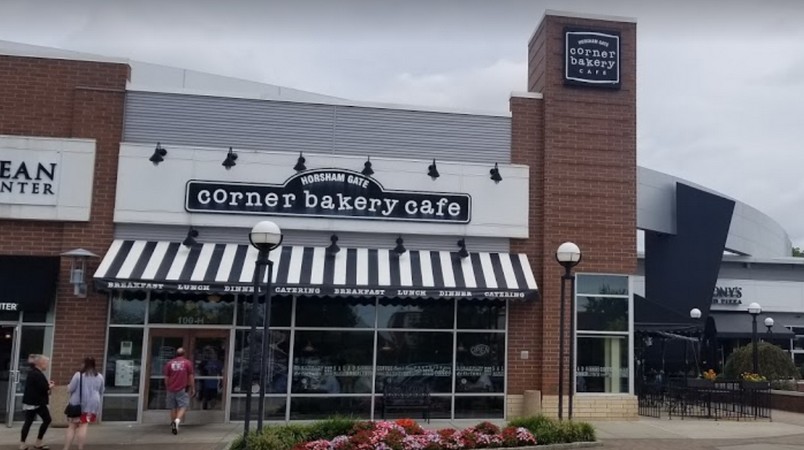
When my haircut was finished, I found my son sitting at a small metal table just outside the entrance of a Corner Bakery, another outlet of the many chain establishments that dot the suburban Philadelphia landscape. An insulated cardboard cup of coffee sat on the table top. I could surmise that my son was indifferent to it, although his eyes were hidden behind the dark lenses of sunglasses. I took the other seat at the table. He turned to me and said, "I'm so glad that there are good coffee places in center city." He extended a finger in the direction of the cup and proclaimed it one of the worst cups of coffee he ever consumed. He went on to describe the events that preceded his occupation of this table. "I ordered a cup of coffee," he began, "and asked the fellow behind the counter if they had non-dairy coffee cream." The fellow replied that they had skim milk, hoping that would satisfy my son's request. Instead of a lesson in how "skim milk" is still a "dairy product," my son just smiled and moved on.

Next on our agenda was a quick stop at a CVS to grab a small pack of tissues to alleviate the sneezing that accompanies my son's severe summer allergies. I was surprised when he came out of the store with a large package of Haribo gummies along with the tissues. Okay, maybe I wasn't that surprised.

Our major planned activity for the day was going to the movies, something I have not done since Christmas Day 2019, when my wife and I subjected ourselves to the uncomfortably grueling Adam Sandler crime drama Uncut Gems. The only thing I remember about that movie was checking my watch every five minutes during the entire 135 minute run time. Then a global pandemic hit, keeping everyone in their homes and movie theatres locked up tight. Now, with abundant vaccinations and COVID-19 cases on the decline, movie theatres are welcoming folks back. 

We had some time to kill before the start time of the movie we had chosen, so we parked and spotted an arcade in the same shopping center as the theater. The concept was pretty innovative. Instead of quarters and change machines, all machines were set on "free play." Players pay a flat rate to play during specific time allotments. For three bucks, my son played a few current and classic video games and pinball machines before the cashier-issued timer sprang to life with a pattern of blinking lights. My son finished defeating the Death Star on the Star Wars pinball game he had selected and we left our little distraction to find a new distraction to eat up more time.

Speaking of "eat," that was exactly what my son suggested. We headed over to hometown favorite Wawa where he ordered the smallest sandwich I had ever seen and I got a cup of coffee. We sat in my car and talked about all sorts of stuff until we figured it was time to venture into the theater. 

The theater had used their time during the pandemic to do a bit of remodeling, specifically they completely eliminated and removed their box office. The now-cavernous lobby now features an array of self-serve kiosks on which tickets came be obtained with a swipe of a credit card and a few touches on the screen... sort of like check-in at an airport. A lone usher — someone in the theater who still has a job — scanned the barcode on my son's phone that served as our tickets. He didn't even bat an eye at the "outside beverages" we were blatantly carrying into the theater. We found the correct theater and sat outside on an upholstered bench until showtime.

We chose The Sparks Brothers as our first foray back into the normalcy of a — dare I even say — post-pandemic existence. (No, the pandemic is not over.) Years in the making, this labor of love from director Edgar Wright tells the tale of Ron and Russell Mael — collectively known as "Sparks" — who have been making incredible, experimental and influential music for 50 years. Never heard of them? I didn't think so. Their career is lovingly chronicled, punctuated by comments from famous fans and fellow musicians. The highlights, the lowlights and everything in between are presented in an engaging format that switches between concert footage, studio interviews, stock film and animation. It's two and a half hours long and I didn't check my watch once. My son and I are both long-time Sparks fans, even having the opportunity to see the band twice. They rarely tour in the United States and I remember at their 2013 show in Philadelphia saying to myself "I never thought I'd ever see this band." When I saw them again in 2015 with the band Franz Ferdinand, I thought the same thing. (My son took me to both of those shows.) We found our seats and when the theater lights dimmed and the film began, we were joined by five more people. It was like a private screening — for all of us. At the film's conclusion, I half-expected an usher to ask, "Did you five folks enjoy yourselves?"

When the film was over and the lights came back on, I informed my son that I needed to use the bathroom for the last hour and a half. Throughout the course of the documentary, each and every one of Sparks' 25 albums are highlighted. I was beginning to panic when I saw they were only up to the albums from the 80s. But, alas... I made it. I realized I have gotten very spoiled by the "pause" button on my cable TV remote.

After the movie, we came back to my house. Mrs. P suggested that we order Chinese food for dinner. My son balked at first, saying he wasn't particularly hungry. However, when dinner arrived, his order of Spicy Szechuan Noodles didn't stand a chance. After dinner, I drove my son home. As he exited my car, he told me he was going to feed his cat then take a nap. It was 9:45 at night. Ah, to be young.

Just a day. But a good day.

Sunday, February 9, 2020

harriet tubman's gonna carry me home

A few years ago, on a particular Sunday in the summer, I was looking for something to do. I realized that I hadn't participated in my favorite hobby — grave hunting — in some time. So, feeling especially lazy, I ventured just a couple of blocks from my house to a small cemetery behind the historical St. Paul's Episcopal Church, one I had passed at least a zillion times in the thirty-plus years I have lived in Elkins Park, Pennsylvania. (I was so lazy, in fact, that I drove there despite it being so close to my house.)

Before I venture out to explore a cemetery, I have to do a little preparation. I scout the grounds with an online map (when available) and a quick search on my favorite website Find-A-Grave, an invaluable resource for the novice gravehunter (and there are a surprisingly large number of us). The results of my search actually left me a bit embarrassed. I have lived in this small, but historically significant, community for most of my adult life, and was not remotely aware of its impact in the development of our country. 

I had passed a sign outside the church that identified one of the buildings as "Jay Cooke Hall." I had no clue who Jay Cooke was. I assumed he was a founder of the church. I don't remember his name coming up in history classes. A bit of research convinced me that my high school history teachers were sorely lax in their duties of educating their students. Jay Cooke was, indeed, a prominent member of the St. Paul's Church congregation, but he also financed the Civil War for the North. Without his contributions, the Civil War would have had a much different outcome. I also found the graves of folks whose surnames grace many street signs and buildings in the area. It's pretty cool to discover that neighborhood landmarks were not just arbitrarily named by a land developer, but were chosen to honor those who shaped a community.

Since my visit to the cemetery at St. Paul's Church, I have looked at the building differently each time I drive by. The Gothic architecture, I learned, was the handiwork of Horace Trumbauer, one of America's premier architects, who constructed additions some forty years after the church first opened its doors to parishioners. Trumbauer also designed a number of residences and commercial buildings in and around the Philadelphia area, including the nearby Keswick Theatre, the main branch of the Philadelphia Free Library and Philadelphia Art Museum, which was a collaborative effort with another architectural firm. 

However, I was still ignorant to a key piece of American history that is buried beneath the church's façade.

At the beginning of 2020, my wife was scrolling through Facebook and came across an announcement for an hour-long seminar about the history of Cheltenham Township, the governing body that Elkins Park lies within. The presentation was hosted by St. Paul's Church and the speaker was a teacher at a local elementary school who, we later found out, did extensive research about the community after wondering why this stuff wasn't taught in school. How pragmatic! I marked my calendar and on Super Bowl Sunday — of all days! — Mrs. Pincus and I walked over to the church for a little schoolin'. I had been wanting to see the inside of the church building for some time and this was the perfect opportunity. Plus, it saved me from lengthy conversion classes.

The main sanctuary is beautiful, boasting high graceful arches, carved wooden augmentation and thirteen stained glass windows created by Tiffany Studios. A portable movie screen was set up in the sanctuary with the first slide of the presentation shining brightly upon it. We took seats among a handful of folks and soon the teacher welcomed everyone. She was excited, enthusiastic, if not a bit tongue-tied here and there. Her presentation was very informative, revealing numerous facts to the crowd — for the first time, by the collective reactions. Of course, she began with Jay Cooke, expounding on the fact that, besides being a financier, he was an ardent and fierce abolitionist. He harbored and transported escaped slaves in the basement of his Elkins Park estate. When he conceived and built St. Paul's Church, he made sure that the plans included tunnels and sanctuary that became a stop on the Underground Railroad system. The teacher noted Cooke's close friend and prayer group colleague Lucretia Mott. Mott was a Quaker who campaigned extensively and tirelessly for the end of slavery. She was also a vocal proponent for Women's' Rights, alongside Elizabeth Cady Stanton and Susan B. Anthony (with whom she eventually fell out of favor). Mott's family leased land in Cheltenham to the Federal government to be used as a military training camp for freed slaves wishing to join the United States Army in the Civil War. Called "Camp William Penn," it produced many African-American only regiments, where other training camps banned enrollment by ex-slaves. The teacher told of the prominent Widener Family, the Elkins Family and other familiar names recognized immediately by the current community, as well as notable visits by Frederick Douglass, Abraham Lincoln and Harriet Tubman.

When the seminar concluded, guests were invited to descend a set of narrow stairs and navigate an even narrower tunnel beneath the church. We followed the now-forming queue and made our way to the staircase. We passed the actual preserved desk where Jay Cooke wrote and signed numerous war bonds in 1862. The stairs emptied into an impossibly narrow passageway that snaked awkwardly until it revealed a boxy room whose floor was strewn with pale yellow straw. In one corner was a pile of makeshift bedding in an obvious recreation of the accommodations offered to those seeking freedom via the Underground Railroad. The tableau was, at the same time, chilling and inspiring. Just knowing that we were walking the same path that so many walked towards the long, frightening and often dangerous road to freedom gave reason to pause and take in the moment. The group slowly shuffled past the room, minding our steps in the darkness, until the lead person reached the next set of stairs and we began to make our ascent back to the main room.

We thanked the teacher and the representatives of the church for hosting the afternoon session. Mrs. P and I found the door we used to enter the maze of a building and started home. I thought about how much history is just a few steps from my home. I thought about how much of this knowledge is unknown to my neighbors and how much time they have wasted worrying about trivial things (like what will move in to the empty building that once housed the neighborhood co-op). Do they realize — or even care — about the history of other — more significant — buildings in the same proximity? I'm not so sure.

www.joshpincusiscrying.com

Sunday, May 6, 2018

I won't back down


This is a story of resilience, tenacity and resourcefulness. And, if you're not careful, you may even learn something.

First, the learning part of this story. As spring tries to emerge from a winter that just doesn't want to loosen its icy grip, Passover, the harbinger of the vernal equinox and the Jewish holiday that commemorates.... er...Pharaoh and Moses and plagues and letting my people go... concluded just last week. In preparation for Passover, my family has always observed  and practiced the traditional rituals associated with the holiday. Over the years, we have become more lenient and relaxed in some areas, but Mrs Pincus remains firm on cleaning the kitchen from top to bottom, ditching everything in the refrigerator and restocking it with food that is certified "Kosher for Passover." For those who are not familiar with the "rules" of Passover, or keeping kosher, besides the basics of "no pork, no shellfish and no mixing meat with dairy" which apply all year long, Passover foods are like starting fresh. They are prepared and are kept clear of non-Passover foods. Plus, depending on your family's specific, sub-ethnic heritage (now, it gets really gets complicated), some foods — like corn, peanuts and rice — are strictly forbidden during the eight day observance. To make things more confusing, some foods are "Kosher for Passover" all the time and their packaging is so labeled.. (Yeah, it took me a while for the concept to "click," for me, too.)

In the week or so prior to the first day of Passover, my wife makes a trip to a supermarket about thirty minutes from our home. Sure, most supermarkets in urban areas stock an aisle with big boxes of matzoh, glass jars of gefilte fish and matzoh ball soup and a few shelves of Passover baking mixes that are just terrible enough to make one vow to just refrain from consuming any Passover cake the next year. The Shop Rite that Mrs P goes to has a rather large and varied selection of Passover foods not available in the average "let's accommodate the Jews for a week" section of our local Acme Market. The temporary Passover department is adjacent to the extensive Kosher section that opened to cater to a pocket of ultra-Orthodox Jews that reside nearby. Among the regular stock of kosher groceries is a packaged meat and cold cut display, many of which is clearly labeled "Kosher for Passover and Year Round Use." Bingo! That's the stuff! Mrs. P scooped up several packages of pastrami, corned beef and salami — all to be enjoyed by her and her meat-eating parents. I am a vegetarian. She filled her shopping cart with other Passover-certified items and headed to the checkout  lane. When she got home, and began to unpack her purchases, she noticed that one package of corned beef was not vacuum-sealed, its contents a pale, sickly beige. It looked small and drawn as it sat awkwardly in its unnerving ballooned package. Mrs. Pincus frowned. She shuffled through the many plastic grocery store bags and located the receipt, making a mental note to return the meat after the holiday was over.

Well, Passover finally ended. I think it may have even run a few days longer than usual. Anyway, after Mrs. Pincus got the kitchen back in order, she threw the suspect corned beef in a bag, grabbed the receipt and we headed out to the Greater Northeast, a misnomer that has attached itself to the far northern tip of the Philadelphia city limits, not far from where I grew up.

We parked and with determined steps, Mrs P bee-lined straight for the Customer Service desk. She presented the receipt and the debilitated package. She pleaded her case to the disinterested young man on the other side of the counter. Suddenly, he seemed to focus on the "Kosher for Passover" legend on the label. Immediately and without listening to another word from my wife, he grabbed a nearby phone and paged a manager. Within seconds, a gentleman in shirtsleeves and a necktie appeared at our side. He interrupted Mrs. P's explanation with a very rehearsed "We are not taking returns on Passover merchandise." And then he grinned a shit-eating grin. Mrs. P furrowed her brow and took it from the top. She patiently (and I mean with the patience of Job) explained that this corned beef, as well as other items, are labeled "Kosher for Passover" all the time. Items that this very store sells all year long. Items that this store stocks at this very moment. The necktied manager with the shit-eating grin nodded and said, "I understand, but we are not taking any returns on Passover items." He continued grinning. Clearly, he did not understand.

Mrs. Pincus began again. Slowly and carefully, she repeated her points. Mr. Manager had obviously lost interest, but stood with his head lolling to one side and pretended to listen. This time, he allowed her to finish before repeating his mantra about not accepting returns on blah blah blah blah blah. Mrs. Pincus was beginning to get a bit tense, much in the way one would get debating important issues with a turnip. I stood a few feet away from the building confrontation, but when my wife mentioned — again — other items bearing the "Kosher for Passover" designation all year round, I took it upon myself to run over to the Kosher deli section and bring back a current package of the same corned beef brand we were returning. And I did just that.

I gave the freshly-picked package to my wife and she waved it in the managers direct, pointing out the words "Kosher for Passover" emblazoned on the label. "My husband just got this from your shelf. If I bought this and returned it tomorrow, you wouldn't accept it?," she asked. With his familiar robotic inflection, he repeated, "We are not taking returns on Passover merchandise." This time, he added that we were welcome to come back tomorrow and speak to the store manager. The store manager? Who the fuck was this guy the whole time. Mrs. P squinted at his name badge. Oh, the assistant manager. "but he won't take the return either.," the assistant added.

"Look," Mrs. Pincus growled thorough clenched teeth, "I am not leaving until I get a refund or a store credit or something." And she meant it. I've known her for 35 years. Oh, she meant it alright. The manager... I mean assistant manager sighed and reluctantly picked a store gift card off a rack. "Okay," he said, "I'll give the amount on a gift card, but I am going to get in so much trouble for this." He loaded the card with the refund amount. Seven dollars and ninety-nine cents. That's right. The assistant manager quarreled and quibbled and disputed over less than eight bucks. Speaking of misnomers, that "Customer Service" sign hanging over our heads was a blatant one.

The next day, my wife called the store to speak to the actual manager. He was receptive, respectful and attentive. First, he apologized profusely for the behavior of his staff. Then he expressed his appreciation of the explanation and said he would be enlightening his staff with this new information about the labeling of Kosher foods.

Guess who'll be the recipient of his first lesson?

www.joshpincusiscrying.com

Wednesday, August 26, 2015

stacks of green paper in his red right hand

"It was made very clear to me what I'm supposed to do here. I smile, wave my little hat... I did that, so when do I get paid?"  — Tom Hanks as Jimmy Dugan in "A League of Their Own" (1992)
Once again, I am confounded by the inability of some people to follow simple rules of conduct... especially when the party making the rules is dropping a ton of money in your lap. Of course, I am referencing two recent stories to break in the news around the same time. One concerns Jared Fogle, the one-time spokesperson for the highly-successful sandwich shop chain Subway. When Jared was an average, unknown college student, he famously dropped over 200 pounds by restricting his food intake to Subway sandwiches (sans fatty condiments like mayonnaise) and walking a lot. His story was brought to the attention of Subway's marketing department and the first commercial featuring the newly-svelte Jared appeared in 2000. He went on to make over 300 commercials for the chain over a period of a decade. Subway partly credits the "Jared" campaign with tripling their growth over that period and they rewarded him accordingly. It is estimated that Jared's net worth is around 15 million dollars. Plus, he was lavished with first-class travel and stays in 5-star hotels, all on Subway's dime. Jared's instructions from Subway were pretty simple. Subway was willing pay Jared to be the smiling face of the company in exchange for exploiting Jared's incredible weight-loss story. Jared only had to show up at publicity events, smile, shake some hands and get paid. No math, no real work and instant celebrity status with no real exhibit of talent. Pretty sweet deal.

Cha-CHING!
But, Jared had a secret and the money fueled his growing ego. While representing Subway, his meal ticket (pun intended), he explored his lust for underage girls, solicited sex from underage girls and expanded his collection of child pornography. Now, I understand deep-seated urges and how they can be acted upon. I also understand self-control. Jared could have easily sought professional help for dealing with a condition of which he was, no doubt, well aware. Instead, he saw what he understood to be an endless supply of money headed his way and chose to indulge his fetishes, possibly falling into the belief that money makes you smart and puts you on a level above most members of society. A plush room at The Plaza, chauffeurs, publicists and an entourage only reinforced that idea. However it all came crumbling down around Jared in August 2015, when Subway severed all ties with him over allegations and an eventual guilty plea to federal charges of possessing child pornography and traveling to pay for sex with minors. Nice work, Jared. If only you would have just done the minimum of what was expected of you.

Cha-CHING!
Almost simultaneously, Josh Duggar, co-star of the wildly popular TLC Network reality show 19 Kids and Counting, got himself into some hot water. His show, 10 seasons strong, was a day-to-day chronicle of the Duggars, a family of devout Independent Baptists. They frequently discuss values of purity, modesty, and faith in God. The Duggars vehemently oppose birth control, saying they have allowed God to determine the number of children they have. Since this has been put into God's deistic hands, the title of the show has changed twice with the addition of two more children. Recently, Josh, the eldest son of baby-machines Michelle and Jim Bob Duggar, was accused of child molestation. This was a shocker for fans of the God-fearing, pious clan, however things grew worse for the 27-year-old Duggar son, when it was revealed that four of his victims were his sisters. As these allegations surfaced in the news, TLC promptly canceled the series, which contributed to Josh's estimated net worth of 200 million dollars. That's right, 200 million! Now, Josh, a proclaimed devotee of his religion, family values and all that self-righteous stuff, has been named as an active member of AshleyMadison.com, a website devoted to hooking up married adults for adulterous affairs. (For those playing along at home, "Thou Shalt Not Commit Adultery" is Commandment Number 7.) Look, perhaps the religious tones of the show were not really within ol' Josh's beliefs and he was just playing along for the sake of his family and the money. But, for goodness sake, Josh, if you could have just kept your hands to yourself and sought professional help with your newly-gained funds, that cash cow would still be flowing with the milk of unlimited wealth. And cheating on your spouse? Really? Was it worth the 200 mil? Because your wife, the former Anna Keller, is gonna take a good chunk of that if she decides to seek a divorce. Or maybe she'll just let God decide that, too. But, obviously, God doesn't take too kindly to that shit either. He did burn those rules into a rock right in front of Moses' eyes. I think he made his point.

A little closer to home, I had a co-worker who was hired with specific instruction as to what his job entailed. He was to keep peace within a particular department that displayed signs of friction. That's all. The department's work output was, otherwise, pretty good. It's just that the individual team members were constantly at each other's throats, filled with contempt and mistrust for one another. This guy was just supposed to unite everyone and readjust the focus of the department to one of harmony. (Ironically, he succeeded in uniting everyone in their dislike for him.) For this task, he was grossly overpaid. Now, despite a clear explanation of his role, he proceeded to make unnecessary, overly-complicated and "un-asked-for" decisions. He also exhibited behavior that was, shall I say, unappreciated by some of the female members of the department. He was reprimanded over and over again, until the company finally had enough. If only he had just followed the concise instructions that were clearly explained to him, he would still be collecting that obscenely-large paycheck. Instead, the salary only served to feed an unwarranted ego, one that he couldn't keep in check. He is currently seeking employment elsewhere.

Cha-CHING!
This behavior is nothing new. Back in the 60s, budding filmmaker Bob Rafelson came up with the idea for a sitcom about a struggling rock group. Taking inspiration from the Beatles and their wild antics in the film A Hard Day's Night, Bob joined up with Bert Schneider, whose father was the head of Columbia Pictures' Screen Gems division, to bring his idea to the small screen. The pair placed an ad in a trade paper, looking for "Folk & Roll Musicians-Singers for acting roles in new TV series. Running Parts for 4 insane boys, age 17-21." Of the nearly 500 applicants (including Stephen Stills and, allegedly, Charles Manson), three were chosen to join the already-cast Davy Jones, a proven Broadway actor who had originated the role of "The Artful Dodger" in Oliver! The three additional young men had their roles clearly explained by Bob, Bert and musical director Don Kirshner. They were actors, not musicians. They were playing the parts of musicians. The music was already figured out and they would have nothing to do with it. With that understanding and their cooperation, they would be paid a lot of money. As simple as that sounds, Mike Nesmith, a country singer-songwriter with a modicum of talent, Peter Tork, an unsuccessful guitarist who, prior to this casting, was working as a dishwasher, and Micky Dolenz, a former child actor who was hired purely on the merit of his "unusual face," understood something different. They were convinced they were chosen based on their musical chops and they were to be the next Beatles. Only Davy, the true professional, got it. He understood that he was not Paul McCartney and this was not the Beatles. This was just another acting role and he was going to hang on to it as long as possible, because he knew acting roles are tough to land on a regular basis. The trio (again, not including Davy) were shocked and insulted when they were barred from participating in a recording session. When the money started rolling in, their egos inflated, ignoring the fact that the success was due mostly to someone else's expert casting and predetermined musical choices. When Kirshner presented the "band" with a check for one million dollars (twenty-five thousand each) and a tape of what he selected as their next single,* an ungrateful Mike Nesmith offered his thanks by slamming his fist through a wall and informing the bewildered Mr. Kirshner "that could have been your face, motherfucker." The Monkees, under the tutelage of Nesmith, sabotaged their success and, in essence, orchestrated their downfall. The show lasted only two seasons. Although their fame endured, only Davy embraced the novelty and happily made it his career, right up until his untimely death in 2012. The others begrudgingly took part in reunions over the years, but then took the money as though it was owed to them. They probably still don't realize that they merely "fit the suit."

What is the moral of these stories? If you think it's "Money is the root of all evil," you weren't listening. The true moral is "Listen. Keep your goddamn mouth shut and listen."

www.joshpincusiscrying.com


*The song was "Sugar, Sugar," eventually recorded by a group of anonymous studio musicians and released under the name of the fictional "The Archies." Kirshner commented that he was forced to create a band that couldn't talk back to him.