Showing posts with label commute. Show all posts

Sunday, October 23, 2022

nobody does it better

See that thing? I don't know what they call those things where you come from, but here in Philadelphia, we call 'em "hoagies." Growing up in Philadelphia, I ate a lot of hoagies. A lot of hoagies. From a lot of different places. Some were good. Some were not so good. The good places received multiple return visits from the Pincus family. But for some reason, despite being satisfied by the offerings of a particular hoagie place,  we often sought other places to fulfill our hoagie hunger.
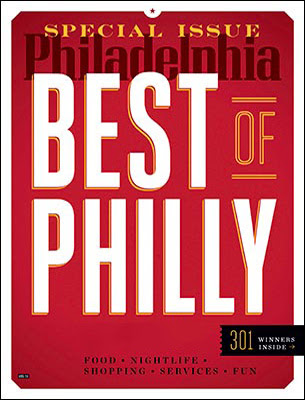
Like most big cities of comparable size, Philadelphia boasted a namesake publication that came out on a monthly basis. Philadelphia Magazine was established in the very early part of the twentieth century, but its heyday was - arguably - the 1970s. During the middle part of the "Me Decade," Philadelphia Magazine presented itself as a scrappy, snot-nosed, street-wise voice of the city. They published hard-hitting, investigative pieces, exposing corruption in city government, criticizing policies and mocking the stately "old regime" of the city. I remember they ran an extremely unflattering piece about a prominent suburban Philadelphia doctor who was accused of over-prescribing dangerous diet pills. (My mom was the recipient of a couple of those prescriptions.) Philadelphia Magazine's acerbic editorial staff were regular critics of overbearing police chief-cum-notorious mayor Frank Rizzo. He didn't like to be criticized, leading the magazine to "poke the bear" even more. Philadelphia Magazine also took pride in its annual "Best & Worst of Philly" issue that hit newsstands every spring. In this double-sized issue, they would print their smug opinions on dozens and dozens of categories from restaurants and services to local newscasters and athletes.... and they'd pull no punches. If a butcher shop or dry cleaner was worthy, the staff of Philadelphia Magazine would lovingly sing their praises. However, they would just as readily disparage an establishment that provided a less than stellar product or below average service. Philadelphia Magazine had the power to make or break a business or to turn an entire city against a particular local public figure. My parents, like most middle-class residents of the City of Brotherly Love, hung onto every printed word in Philadelphia Magazine like it was the Gospel.

During one of my years in high school, Philadelphia Magazine deemed Greenman's Deli as offering the "Best Hoagie" in the city. This caused something of a mild outrage, what with ethnically-uniform South Philadelphia literally teeming with Mom and Pop hoagie shops. You can't swing an aged stick of sopressata without hitting one. How could some corner delicatessen in — gulp! — Northeast Philadelphia compete with any number of authentic Italian sandwich-makers within spitting distance of Passyunk Avenue? But Philadelphia Magazine defiantly stood by its decision, describing the cold-cut and veggie-stuffed sandwiches being akin to ambrosia on an oil-soaked long roll. As a long-time supporter of the underdog, my father loved reading this. Too timid to do it himself, my dad relished hearing about some high and mighty big shot getting put in their place. After finishing the lengthy article about what was good and what was bad in our hometown, my dad made a plan to partake of Greenman's Deli's hoagies as soon as possible.

When the weekend rolled around, I went with my father to Greenman's Deli. Sitting in the passenger's seat of his Dodge Dart, I gazed out the window at the unfamiliar surroundings. I couldn't remember ever being in this neighborhood before. My father rarely — rarely — drove out of his cocoon-like comfort zone, never venturing beyond the invisible confining barrier that was Cottman Avenue (a ten-minute drive from our house  no exaggeration). At the corner of Brous and Levick Streets was the very unspectacular Greenman's Deli. An illuminated sign reading "Greenman's Deli" below the familiar Pepsi logo proclaimed its territory. Its two windows were topped with removable letter signs. The letters were arranged into the identifying statement: "THIS IS GREENMAN'S." These signs, in direct contrast to the one over the door, featured the equally familiar Coca Cola logo. My father's grin widened as he parallel-parked his car just a few feet from their entrance. Inside the cramped store, we maneuvered down the small, narrow aisles filled with staple groceries towards the deli counter that spanned the rear. After scanning the large menu board, my dad told his selections to an older man in a white apron who scribbled notes on a folded brown paper bag with a thick grease pencil. Then, he set to work building... constructing.... erecting a series of enormous hoagies that would be the Pincus family dinner that evening. He stuffed impossible amounts of sliced deli meat and cheese between two golden-brown surfboards that, upon closer inspection, turned out to be hoagie rolls. The gigantic heaps of processed proteins were supplemented by piles of shredded lettuce, peppers, onions and tomatoes, along with generous sprinklings of spices and glistening splashes of oil. When completed, the man wrapped each hoagie in a length of butcher paper with the deftness of a Cuban cigar roller. My dad paid and we headed home with our bounty. That night, the Pincus family feasted like cold cut kings. I think it took me several sittings to finish my hoagie. And I remember it being really, really good. We returned to Greenman's only a few more times after that initial trip... because after a while, the senior Pincus fell back into his old "limited traveling" habits and we found ourselves getting hoagies from someplace closer. Some place not as good.

Last year, I started a new job that takes me to Pennsauken, New Jersey. Every morning, I drive from my suburban home, on a route that snakes through Northeast Philadelphia, and right past Greenman's Deli. Before I began to take this daily commute, I hadn't seen Greenman's Deli in over forty years... maybe even longer. But now, I see it every morning.

And it's sad.

I pass Greenman's at approximately the same time every morning, give or take a few minutes. Sometimes it is open for business. Sometimes the protective security gate is down and locked tight in front of the entrance door.
The windows are dirty. A Dumpster overflowing with trash and flattened cardboard boxes sits just outside the door, next to an ancient ice machine whose painted graphics have faded and peeled over the years. When the security gate is up, the great neon-rimmed clock above the door displays the incorrect time. Sure, it's early in the day, but I have rarely witnessed a customer going in or coming out of Greenman's when sitting and waiting for the traffic light to change. 

I did a little online investigating of Greenman's. I found a bunch of reviews declaring new owners. Most went on to condemn the new management, some sadly and unnecessarily resorting to  a barrage of racist comments. Most also lamented over the steady and noticeable decline in the quality of their signature hoagies. Some cited stale bread, dry corned beef and a lack of vegetables. Others reminisced about the once-great product provided by the long-time, long-missed previous owners. A few reviewers touched on rude treatment from the current owners and staff. While there were some positive sentiment, the overall consensus was that the glory days of Greenman's Deli are gone and will, most likely, never return.

Luckily, there are still plenty of places to get a good hoagie.

Sunday, November 24, 2019

build a bridge to bring both sides together

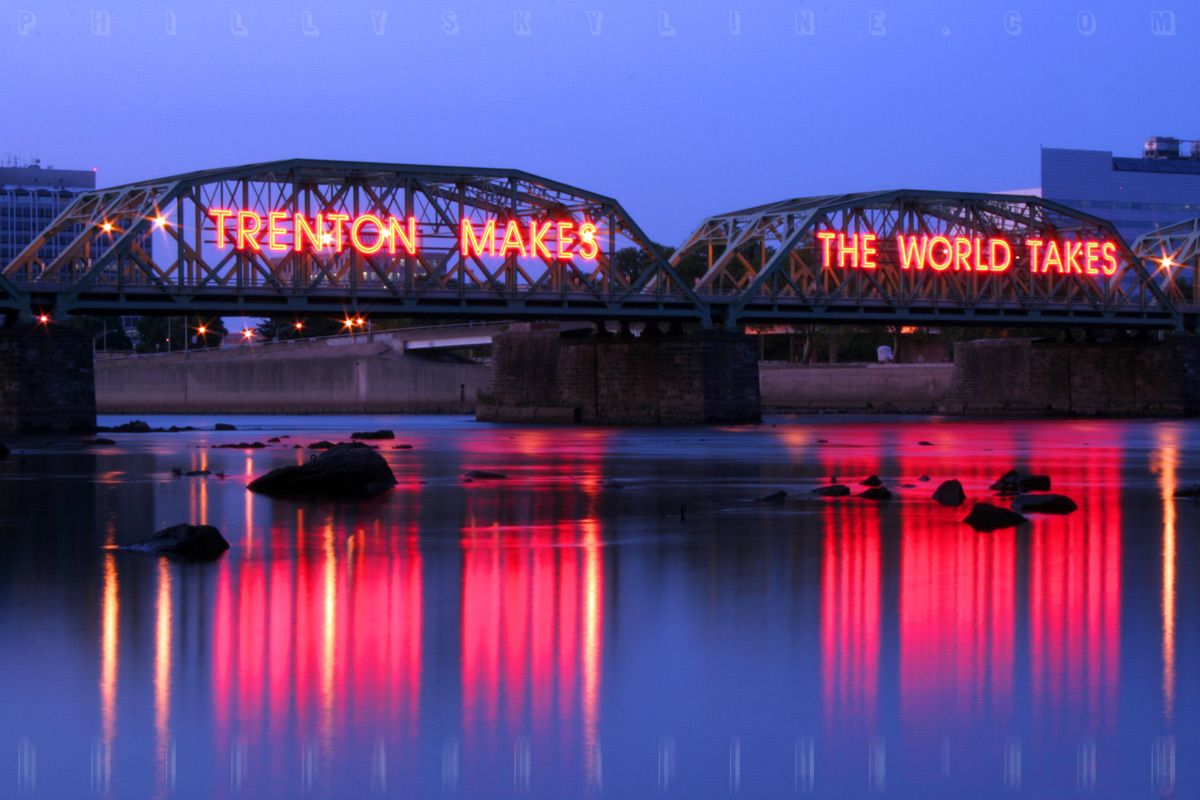
Every day — twice a day — I pass the Lower Trenton Toll-Supported Bridge, that straddles the Delaware River between Trenton, New Jersey and Morrisville, Pennsylvania. No toll is collected from drivers crossing the bridge, making it one of just a handful of toll-free bridges leading out of the Garden State. Officially, the Lower Trenton Toll Supported Bridge is designated as part of US 1 - Business Route, however, US 1 - Business Route doesn't really cross the bridge. It's actually Route 32, but not until you are in Pennsylvania. The Lower Trenton Toll Supported Bridge has even been featured in a few movies, including 1954's Human Desire and 1988's Stealing Home. The real claim to fame for the Lower Trenton Toll-Supported Bridge comes from the somewhat arrogant slogan that adorns the southside span in seven-foot high neon letters. It reads "Trenton Makes The World Takes" and it is renowned (and even reviled) by those all over the Greater Philadelphia and surrounding area.

The Lower Trenton Toll Supported Bridge, which is known colloquially as the "Trenton Makes Bridge," opened on January 30, 1806, exclusively as a railroad bridge. It was the first railroad bridge in the United States to be used for interstate rail traffic. To keep up with the growing demands of railroad traffic, the bridge was rebuilt and reinforced four times over the years. 

In the spring of 1918, the Pennsylvania Railroad sold the bridge to state government of New Jersey and the tolls were removed. It was again rebuilt in 1928, after it was designated as an automobile traffic bridge for US Route 1. 

In 1910, the Trenton Chamber of Commerce ran a contest for a city slogan. Trenton, at the time, was a leading manufacturer of a multitude of goods, most notably steel, rubber, wire rope, linoleum and ceramics. New Jersey Senator and local businessman S. Roy Heath submitted the slogan "Trenton Makes The World Takes" and it was chosen as the winner. It appeared in brochures and on other printed material promoting the city of Trenton. In 1911, the slogan was affixed to the side of the Lower Trenton Toll Supported Bridge in large metallic letters. In 1917, the slogan was enlarged and illuminated with 24,000 incandescent lamps. In 1928, the sign and lights were removed and the bridge remained dark until an even bigger version was installed in 1935, this time the letters shone in bright glowing neon.

The sign and bridge, like much of the city of Trenton, fell into a dreadful state of disrepair. However, in the early 1980s, as part of a citywide revitalization, the sign was once again replaced with the biggest version yet.  In 2005, the sign received additional upgrades to lighting technology, including LED lights and multiple changing colors. More upgrades are scheduled as well.

Yet, as folks (like me) cross the adjacent Trenton-Morrisville Bridge (on the actual Route 1, where the toll is a buck), we still silently scoff at the boastful claim that the Lower Trenton Toll Supported Bridge makes on behalf of a once proud city. Because we are Philadelphians and that's what we do.

Sunday, October 6, 2019

highway patrol

For nearly twelve years, I took public transportation — specifically the Philadelphia Regional Rail line — to work and I was admittedly spoiled rotten by the convenience. I hate to drive, so letting someone else do the driving — while I read or slept or took pictures of people blatantly ignoring the policy of keeping bags off of seats —was perfect for me. I got a discounted rate on a monthly transit pass and my car sat in front of my house six days a week, only taking it from its curbside resting place to pick up dry cleaning on most Saturday mornings. Well, my daily train commute ended when I was unceremoniously separated from my center-city employer. After a long absence, I was thrust into the nerve-wracking, white-knuckle world of driving to work.

I started a new job in August 2019. My office is located just ten miles north east of Trenton, New Jersey, in a small community called Robbinsville. It is not in close proximity to any single mode of public transportation. So, I have no choice but to leave my house at ten after seven and navigate through unpredictable traffic to arrive at work for an 8:30 start of day. In the first week of my new employ, I tried several different routes, including a stretch of the New Jersey Turnpike that collects a six dollar toll in both directions. I finally settled on a course that costs a dollar in only one direction and takes me past the 6100-seat Arm and Hammer Park, home of the Trenton Thunder, a Double-A affiliate of the New York Yankees. I also see an alleged homeless guy, displaying a handwritten plea scrawled across a piece of corrugated cardboard, wandering in and out of the traffic waiting to make a left turn on to Route 29. He wears different clothes and a different baseball cap everyday, leading me to believe that he is no more homeless than I am.

I am actually getting used to driving. I have mentally broken down my commute into sections, checking my dashboard clock and figuring what kind of time I am making based on where I am at a particular time. Sometimes, I ignore the clock and just happily listen to the radio.

Then, of course, there are those times when the traffic comes to a grinding halt. It's these times that makes me hate driving. If I am stuck in bumper-to-bumper traffic for a period of time longer than a few minutes, I get anxious and antsy and frustrated. I hate inching along, closing up the gap between my car and the car just ahead, as though those few extra millimeters are accomplishing something. And, when the traffic snarl finally breaks and the pace resumes to regular speed, if I don't see a twisted hunk of sheared metal that used to be a car or a mass of bloody, mangled bodies littering the blacktop with severed limbs, I am genuinely disappointed. If traffic is stopped, there better be a goddamn good reason for it.

Damn this traffic jam!
Just this week, I was tooling south on Route 1, hitting my each of my regular milestones at the times that let me know I would be parking my car in front of my house at the usual time. Suddenly, just ahead, I could see the faint illumination of brake lights. As I approached and decelerated, the steady glow of brake lights increased as more and more cars were slowing and stopping across both lanes. I tensed up, my hands gripping the steering wheel tighter. I moved a tiny bit outside of my lane, trying to see if I could identify the cause of this slowdown, but I was too far back from the cause. So, I sat. Sat along with a crush of other folks who just wanted to get home in a reasonable amount of time. The knot of cars slowly... slowly... moved forward. After a few long minutes of crawling an inch at a time, I spotted the top of a large, electric sign parked in the far left lane. It was flashing a large, electric yellow arrow, obviously indicating that all traffic was to divert to the right traffic lane. This was quite a request. It was approximately 6 PM, the peak of the evening "rush hour" on a piece of highway that is heavily traveled by both cars and trucks. Big trucks. I could see exasperated drivers craning their necks as they jockeyed their vehicles out of the prohibited lane. I could see truck drivers leaning out of their cab windows checking their massive mirrors to see if they were clear to merge. After a few more long minutes, I finally reached the source of the obstruction.

There was a crew of a dozen or so workers, decked out in florescent vests and scrambling around like beavers all over the highway. They were installing shiny new pieces of the guard rail that divides the northbound traffic from the southbound traffic. AT 6 O'CLOCK IN THE EVENING! RUSH HOUR! Someone who works for the Department of Transportation must know that this is rush hour. Yet, it was determined that this was the optimum time to replace the guard rail. Was it decided during a road maintenance meeting that it was much better to disrupt the busiest traffic time of the day than to wait until a time when the road was relatively empty, when it wouldn't inconvenience too many people?

The next morning. I passed the part of the road —from the opposite direction —where the guard rail was replaced. It was beautiful — gleaming silver and expertly installed.*

I still hate driving.

www.joshpincusiscrying.com

* That there is what you call your "sarcasm."

Sunday, April 15, 2018

I've been driving all night, hands wet on the wheel

I hate to drive. I always have. It's a chore and a hassle and I just don't like it. My wife, however, loves to drive. So, you might say we have a marriage made in Detroit.... or something like that. (We both drive Japanese cars, but, for the sake of a joke, you know what I mean.)

I drove to every job I ever had and hated every gut-wrenching, white-knuckled minute of it. I hated driving in bad weather, especially when it snowed. I am not a particularly good driver (oh, I'll admit it) and sometimes I have difficulty navigating slick and snow-covered streets. I am also fearful of other drivers who don't change their reckless driving habits to suit the weather conditions. 

In 2007, I started a job that allowed me to take the train everyday. That was great. My car sat in the same parking space nearly six days per week, while I sauntered, carefree, to the train station that is conveniently located at the end of my street. Even on weekends or evening events, I would opt to take the train when my destination was downtown Philadelphia (which it often was). Sure, I had my share of complaints about my daily train commute — passengers putting their bangs on the empty seat next to them, despite posted policy comes to mind — but, compared to driving.... well, there was no comparison.

Now, eleven years later, I find myself back in the fast lane. Sort of. I started a new job and I no longer will be taking the train to work. I drive. Luckily, my work hours allow me to leave my house and drive in the direction where I can see a huge majority of drivers from Philadelphia's northern suburbs inching their way towards the city. The traffic in the opposing lanes moves at a snail's pace as I happily zip along on the wide open macadam. I get to hear the morning show on my favorite radio station and it's pretty smooth sailing for the approximately forty-minute drive.

But, all things in this world are not perfect. Several times during the last two weeks, I have encountered a traffic stoppage due to a train crossing (how ironic!) and several drivers who were more interested in their cellphones than paying attention to the other cars on the road. I was behind a fellow on a single lane road who nearly hit the curb twice and crossed the double yellow line three times as he leaned over towards the passenger seat in his car, his head only popping up when he needed to make a quick steering adjustment. I was delayed this evening by an accident and a number of cars not wishing to yield to an approaching ambulance.

Perhaps, I will get used to being a regular driver again. Now that I think about it, I suppose it's people I have to get used to.

Sunday, July 30, 2017

I'm going off the rails on a crazy train


I have a "love-hate" relationship with SEPTA, the entity that provides and operates public transportation in the Philadelphia and suburban area. It is one of only two transit authorities in the United States that operates all five major forms of land transportation (buses, trains [regional rail], subway and elevated trains, trolleys and trolleybuses). SEPTA, an acronym for Southeastern Pennsylvania Transit Authority, does none of them well.

I have been a regular commuter on the SEPTA regional rail for over ten years. Sure, it's a pleasure not to have to drive to work and fight traffic, especially in bad weather (which Philadelphia gets a lot of). But. in those ten plus years, SEPTA has exhibited some of the most consistently worst service I have ever seen from a consumer-oriented company. My morning train — the one I take to work at the same time every morning — has never ever been on time. Ever. A SEPTA representative, who was handing out some public relations material one morning at the train station near my house, told me that "railroad standard" allows trains to be within six minutes of the scheduled time and still be considered "on time." I scrunched up my face and replied, "First - the standard is determined by the industry itself? Then why bother to make a precise schedule if the listed times are, in reality by your own admission, approximate times. Second - if the medical profession worked that way, a doctor could remove your kidney, but, since it's within the area of the appendix, it's still considered a successful procedure." The SEPTA guy laughed, shrugged his shoulders and handed me a pamphlet.

The staff on the trains are pretty rude also. They rarely announce upcoming stations. They snap at commuters with questions. They are the furthest thing from courteous. And they never apologize for the train being late, or crowded, or hot (in summer, when the air conditioning fails), or cold (in winter when the heat fails). My feeling is: they are already at work. What do they care if you're late for work.

So, with poor service, late trains and rude employees, SEPTA feels totally justified in raising fares and not doing a thing to improve themselves.

Yesterday was the clincher. I boarded my train at the train station near my suburban Philadelphia home. It was late, as usual. I found a seat in the last car and sat down. Something on the seat across the aisle caught my peripheral vision. I turned my head and saw a rather large key resting in the center of a seat meant to accommodate three passengers (a "three-seater," as we regular commuters call them). I instantly recognized the key as one used by train conductors to open and close the train doors, as well as operate other functions aboard the train. From my observations, it is an integral piece of equipment in a train conductor's arsenal and one that should be kept close at all times. By this one was alone on a empty seat in a train car conspicuously devoid of all SEPTA personnel. I immediate pulled my phone from my pocket to snap a picture and display it on Instagram for all the world to see. (I regularly chronicle SEPTA's and SEPTA rider's infractions on Instagram, mostly blatant violations of the "Dude, It's Rude" campaign that attempts — and fails — to discourage people from putting their bags, backpacks or briefcases on the empty seat next to them, while offering a gentle reminder that seats are for paying customers.) I quickly focused and got the shot, frantically tapping out a smart-ass caption to accompany the image. I chose to go with: "Is that the key to the entire SEPTA Regional Rail System just, absentmindedly, left on a seat? Ahh, SEPTA, it's a good thing you don't guard our nuclear weapons." Because my social media accounts are linked, my message appeared on Twitter, as well.

Well, SEPTA's social media account (for reasons only known to them) follows my Twitter account (@joshpincus for those of you who dare). Almost immediately, I was contacted via Twitter by one "KW" who was monitoring the SEPTA Twitter this particular morning. This was our exchange:


This little conversation shows SEPTA's sheer laziness and complete lack of customer service. Sure they are confined to 140 characters per message, but they didn't come close to the limit. They barked questions are me, a customer, as though I were responsible for their error. "What train? What car number?" Not a "please" or an "excuse me" or a "would you mind." The train number and car number are two pieces of information that are not easily ascertained by the general public. These numbers are usually posted on the lighted informational boards at the train stations (My station does not have one of these boards.) or on the SEPTA smartphone app. Train numbers are never used by commuters and are the source of confusion when SEPTA uses them in updated schedule and train arrival announcements. My admittedly rude reply ("I don't work for SEPTA") was still met with a pressing and impolite demand for these obscure identifiers. I finally conceded and pulled up the app on my phone to find which train number I was currently riding on.

The train pulled into Suburban Station, my destination for work. I rose to exit the train. A spotted a guy sitting in the seat when I had seen the key. He gathered his belongings (which were disobediently occupying the space next to him) and, in one motion, scooped up the key with his stuff. He palmed the key like a seasoned magician and scooted out into the train aisle just ahead of me. He left the train. He did not appear to be seeking out a SEPTA employee.

Will this guy be opening and closing the doors on tomorrow's commute? I don't know. Will he be making any unscheduled stops based on a whim? I don't know. Will that key be dangling from a chain, RUN-DMC style, the next time I see him on the train? Perhaps.

Do I really care? I do not.