
Showing posts with label jewish. Show all posts

Sunday, December 14, 2025

I'm dreaming of a white christmas

"I'm dreaming of a white Christmas/Just like the ones I used to know"

Are you? Are you really? Before the early 1940s, nobody was really dreaming of a white Christmas. Sure, folks thought about Christmas and all the things that came along with the Christmas season. Presents, family gatherings, sending Christmas cards, a visit from St. Nicholas... well starting in 1823 when that poem was first published. But the concept of a "white Christmas" didn't become "a thing" until a Jewish immigrant named Irving Berlin wrote a song called "White Christmas." Before that, Christmas songs were mostly religious in nature. "White Christmas." made its public debut on Christmas Day 1941, just a few weeks after the infamous attack on Pearl Harbor. Popular singer Bing Crosby sang the song on his radio show. He recorded it the following May for inclusion on an album released ahead of the holiday-themed motion picture Holiday Inn, which debuted, inexplicably, on August 4, 1942. The song performed poorly in its initial release. Bing Crosby wasn't especially thrilled by the tune, commenting during the recording session: "I have no problems with that one." But as Christmas 1942 approached and Holiday Inn gained traction, it topped the charts and became an international hit. It went on to sell fifty million copies, becoming one of the best selling singles of all time.

But, how many folks in later generations, even know why they want a white Christmas? They certainly don't want a white Christmas in Australia, where it's summer in December. So, a white Christmas is purely a Northern Hemisphere thing. Before Irving Berlin penned that beloved Christmas song, the concept of a white Christmas was barely a thing. It was alluded to in Charles Dickens' classic novella A Christmas Carol. Snow and wintery weather was described, but it was not the main focus of the story. It merely offered a setting in which the action took place.

I used to work with a couple of women who were very nice, very sweet, but not too bright as far as where their holiday traditions originated. First of all, they marveled at the fact that I was Jewish. They had never known anyone — anyone! — who didn't celebrate Christmas. They questioned me about holidays that they had never heard of, as though I was the Jewish equivalent of the Pope. (By the way, there is no Jewish equivalent of the Pope and if there were, it sure wouldn't be me.) When Christmas time would roll around, the questions were brought up again. It became tradition. "You don't have a Christmas tree?," they'd ask, as though they were asking how I was able to breathe without lungs. I'd explain that, of course, I had a tree, but I just keep it in the backyard, growing in the ground with the other trees. Being the sarcastic jerk that I am, I would often return the questioning, with a little bit of Josh Pincus attitude. "Why do you want a 'White Christmas'?," I'd innocently ask. "There wasn't any snow in the desert when Jesus was born." The two women would exchange blank looks and then look at me. They'd frown and furrow their collective brows, hoping that would force a convincing answer the front of their brains. Finally, one of them replied. "Well, you know..... it's nice for the kids." 

What? What does that mean? How did that attempt to answer my question? How does that explain your tradition? Jeez! I went on and on and on about Judah Maccabee and his ragtag band of soldiers fighting off the Greco-Roman Assyrian army (or whoever they fought) and how the oil in the temple lasted for eight days instead of just one and why we eat fried food to commemorate the "oil" aspect of the Chanukah story. Okay, okay... I fudged on some of the details, but at least I was far more convincing than "It's nice for the kids." That made as much sense as yelling English into the face of someone who doesn't understand English to get them to understand.

I get frustrated by "traditions" that are blindly followed by people who don't even know the reason why they are doing what they are doing. There are so many Christmas "traditions" that are dragged out every year that have absolutely nothing to do with the birth of Jesus. A lot of them were borrowed from other cultures. There is nothing wrong with that. But if you don't understand why you are doing these things, you kind of look like a dope. Even an excuse of "Well, my parents did this, so I'm doing this" is better than "Uh... I don't know." I had another coworker at another job who would talk about all of her cherished family traditions as though these rituals were handed down from generation to generation... only to discover that her "traditions" were read about in a magazine during her train commute into work that day.

If you are "dreaming of a white Christmas," good for you. If you like snow, that's fine. If it's because a songwriter told you to over eight decades ago, that's fine. If it's because "Uh... I don't know." Well, as they say in the South: "Bless your heart."

Sunday, December 7, 2025

shticks of one and half a dozen of the other

When I was little, I had a bunch of kids from my block over to my house for a birthday party. My mom arranged for a bunch of games for my guests to play, like pin the tail on the donkey and musical chairs. For our version of musical chairs, I selected the record that my mom would play and stop during the course of the game. I selected "The Let's All Call Up A.T.&T. and Protest to the President March" from Allan Sherman's second album My Son, The Celebrity. I knew every word to that song. (As a matter of fact, I knew every word to every song on the five Allan Sherman albums that my parents had in their modest record collection.) The kids who came to my party had never heard this song before. You see, in a few years, these kids — the same ones who were jockeying for that last chair in my living room and stuffing themselves with birthday cake — would be made aware of the fact that the Pincus family were Jews and Jews killed Jesus. And, in their naïve eyes, that crime would be pinned squarely on me. But for now, they just listened to the silly song that played on our record player and eyed up the chair that they hoped to snag when the music stopped. The song — as far as they were concerned — was just an upbeat march. They were oblivious to the other tracks on the album. Tracks like "Al n' Yetta," "Harvey and Sheila," "When I Was a Lad" and other titles with a decidedly Jewish slant. None of these kids' parents owned any Allan Sherman albums. Nor would they ever.

My mom introduced me to the songs and humor of Allan Sherman. I thought the songs were funny, even if I didn't get all the references and jokes. I was six years old, for goodness sake! I had no idea who Benjamin Disraeli or Billie Sol Estes were. I had no clue that the tunes to which Allan sang his silly lyrics were actual songs. But, for some reason, these songs 
these albums — struck a chord with me. I just loved them.

When  I got a little older, I discovered the Dr. Demento radio show. Along with such novelty classics as "Fish Heads" and "The Cockroach That Ate Cincinnati," Dr. D often played a number of Allan Sherman tunes that I recognized from my youth. I still knew all the words, only now, I was finally getting more of the jokes. I finally was able to appreciate the clever wordplay Allan Sherman put into his parody lyrics. It was like I had unlocked a secret door and I was permitted to enjoy these songs — that were beloved to me anyway — in a whole new light. I was always intrigued by the definite Jewish appeal of Allan Sherman's music. It's kind of like Seinfeld or Mel Brooks movies. You don't have to be Jewish to enjoy and appreciate it, but if you happen to have been born and raised in a Jewish family, there are definitely a bunch of additional jokes you are privy to.

Allan Sherman's debut album was the fastest selling album at the time... and that time was 1962. That means two things. One - I am 64. I am at the tail end of Allan Sherman's first wave of fans. The original buyers of Allan Sherman's albums are dying off and their children, who enjoyed the songs secondhand, are also approaching the twilight of their twilight years. Most people in their 20s, 30s and 40s are not especially familiar with Allan's musical output. And two - Allan's efforts were soon eclipsed by four mop-top youngsters from Liverpool, England, whose infectious songs had far more impact on modern music than that chubby little guy's daffy little ditties. 

A few weeks ago, my son — a DJ on a local radio station — told me of an upcoming Allan Sherman tribute show planned for right here in Philadelphia. Thanks to our combined love of Allan Sherman, my wife and I made sure that our son was well versed in the celebrated satirist's music. The show, entitled Glory Glory Allan Sherman, a play on a play of Allan's Semetic-tinged take on the "Battle Hymn of the Republic" is sort of a preview of a proposed traveling revue with planned performances in other cities. The show would also honor the late music impresario Hal Willner and would be presented in Hal's eclectic and inimitable style. Tickets were secured and we counted the days.

The night of the performance arrived and the audience was just as I had imagined — comprised of collection of folks around my age, some older, not many younger. To be honest, if the event had taken place closer to September, one would have mistaken the entire assembly for Rosh Hashanah services. The roster of scheduled performers were recognizable names from Philadelphia and New York musical circles. After a few brief announcements (hmm... maybe it was Rosh Hashanah services?) the evening kicked off with an uneven and somewhat clunky take on Allan's best known song "Hello Muddah, Hello Faddah." Led by NRBQ's Terry Adams on piano, the otherwise silly song about a sad camper's lament was punctuated by an otherworldly interlude by 101-year old avant-garde saxophonist Marshall Allen of the legendary Sun Ra Arkestra. (Allen has made his home in Philadelphia since 1968.) While Allen's contribution was indeed mesmerizing, Terry Adams' out-of-kilter cadence of the lyrics was a bit disorienting and a lot confounding. A few low discontented grumbles made their way through the audience until the song's conclusion.
 
The show was put back on track and went full-speed ahead when Eric Bazilian, founding member of hometown rock heroes The Hooters, took the stage to offer an inspired interpretation of "Seltzer Boy" from Allan's My Son, The Folk Singer, complete with jarring percussion and Bazilian's soaring, plaintive vocals. One by one, Allan Sherman's joy was brought to fresh life by a stable of talented singers and musicians. The audience clapped, and in some cases, sang along to unforgettable bits of comedy like "One Hippopotami," "Sara Jackman," "Harvey and Shelia" and a slew of others.

A dapper Wesley Stace (the former John Wesley Harding), clad in a slick tuxedo, stirred up his British roots with a hilarious reading of "Won't You Come Home, Disraeli." The always unpredictable Rodney Anonymous (of esteemed Philly anarchists The Dead Milkmen) prowled the stage as he offered up a raucous assault with "A Waste of Money." (Rodney told me later that he really wanted to do "Pop Hates The Beatles," as he shares the same "distaste" for a certain Beatle drummer with me.) Low Cut Connie's piano-pounding Adam Weiner rendered an eloquent recitation of "You Need An Analyst" following an hysterical commentary about how half the audience were seeing therapists and the other half are therapists. Eric Bazilian then returned to the stage and strummed out the pseudo-Western "The Streets of Miami" while delivering the tale in a spot-on Old World Yiddish accent. (Perhaps, some day, he'll give us an "All You Zombies" with the same inflection.) The highlight of the evening was the incomparable Robert Smigel stealthily operating the endearing but vicious Triumph the Insult Dog as he "barked out" Allan's familial sing-along "Shake Hands with Your Uncle Max," replete with an endless supply of reappearing cigars. 

The whole cast appeared for the finale, "The Ballad of Harry Lewis," a tale of a brave garment worker would "went down with the ship" and the source of the show's title, followed by a few rousing choruses of "Don't Buy The Liverwurst." Afterwards, the entire cast happily mingled with guests, exchanging stories and anecdotes and precious memories. Everyone was there — whether on the stage or in the seats — to celebrate their shared love of Allan Sherman.

Eric Bazilian, Rodney Anonymous, Adam Weiner, Wesley Stace  all love Allan Sherman

And celebrate they did.

* * * * * * 

BONUS! Here is Wesley Stace, Eric Bazilian and Rodney Anonymous onstage together — something you will never ever see again. Allan Sherman's music is capable of magical things.

Sunday, March 16, 2025

get out of here with that (boom * boom * boom)

As a twenty-plus year seller on eBay (Oh for crissakes! NO! She will not sell your stuff!), Mrs. Pincus joined a Facebook group called "eBay For Beginners." She joined to offer her years of experience on the commerce website to those who are just starting out as sellers and are overwhelmed by the whole thing. The membership is mostly comprised of novice sellers, hoping to cash in on the untold riches they've been told are available on eBay. On a daily — sometimes hourly — basis, folks posts questions and scenarios that are filled with a combination of wonder and wrong information. After reading responses to these questions, Mrs. P chimes in with a clear-headed solution, based on a previous experience with the issue at hand. After twenty-seven years, she has seen it all and has become somewhat of an expert on the ins and outs of the mighty online auction and "buy-it-now" website. She has fielded questions about shipping and the head-scratching policies of the United States Postal Service. She has deciphered eBay policies that can sometimes be very confusing to new sellers. She has offered tips and tricks to make for more visible and enticing listings. She has even identified mysterious items that someone discovered while digging through Grandma's attic in hopes of finding some priceless antique that will result in a huge monetary return.

Like this one...

An anonymous member in the group (as anonymously identified by the user name "Anonymous Member) posted multiple images of a particular item. The user asked for assistance in identifying this piece. The item in question — a double ceramic cup decorated with dainty flowers and a large handle joining the two vessels — was like nothing this particular user had ever seen. They came to the good, sometimes helpful, folks in the "eBay For Beginners" group for some help.

In addition to her years of eBay experience, Mrs. Pincus has many more years of experience attending assorted Jewish religious services and practices. Immediately, upon seeing the photos, Mrs. P knew exactly what she was looking at. She explained that this was a ritual handwashing cup that is used before a meal. A blessing is recited and a bit of water is poured from the cup onto each hand to cleanse before eating. The wording on the overarching handle reads "Al Nitilat Yadayim" in Hebrew. It translates to "taking up of the hands." She went on to explain that these cups are made from a variety of materials, including copper, silver, glass even carved wood and some come with a bowl to catch the excess water. Most often they are a single cup with two handles. Mrs. Pincus commented on the uniqueness of this one, adding that, although she had never seen on quite like it, it was most definitely a ritual hand-washing cup. (Curiously, it does not have a specific name, like "sure, that's a piece of clothing, but it's called a scarf" or  "yes, that's a part of a cow's muscular system, but it's called a hamburger.")

The anonymous user thanked Mrs. Pincus for the information. But, because it's the "never satisfied" internet, a few comments under Mrs. P's clear and concise explanation, was a comment from another member of the group who offered a contradictory take on the object, as though this was a game of  The Liar's Club. This person — one Janet Roberta Mahoney — asserted that, and I quote...
"I disagree that it's for handwashing as pouring from one side spills the other. Can't tell from the photo how big it is. Is the open part connected between the 2? If so, I'd say it was a vase."

I'm going out on a limb here, but I'd say that Mrs. Pincus has been to many more Passover seders than Ms. Mahoney. I would venture to guess that Mrs. Pincus has held as many ritual hand-washing cups as Ms. Mahoney has held shillelaghs. While I wouldn't question Ms. Mahoney's knowledge of leprechauns, the Blarney Stone or St. Patrick's secrets of ridding a country of snakes, I would like to know how many times she has sat through the full reading of the Magillah, how many times she kisses the mezzuzah affixed to her door jamb before she leaves the house or  how much cholent she has eaten in her lifetime. If the original post featured a photo of a thurible, I would trust Ms. Mahoney in her assessment and explanation of that piece and its function in the rituals of the Catholic Church. But, alas, it was a photo of a hand-washing cup adorned with Hebrew writing — something with which Mrs. Pincus is intimately familiar. This is a case of staying in your lane, Ms. Mahoney, even if that lane is on the left side of the road.

I have often said that Mrs. Pincus is the nicest person I know. I don't say that just because she is my wife. I genuinely believe she is the nicest person. However, after hanging around with ol' Josh Pincus for over forty years, some of that "Josh Pincus"-ness has unfortunately rubbed off on her. Every once in a while, a "Josh Pincus"-style remark slips through when a more "Mrs. Pincus" reply would be expected. Mrs. P read Ms. Mahoney's comment and replied: "You're wrong."

Kinehora.

www.joshpincusiscrying.com

Sunday, December 17, 2023

jam up and jelly tight

By the time you read this, we will be in the throes of Chanukah... probably the seventeenth or eighteenth day by now — I kind of lost track. Chanukah, as you may or may not know, commemorates the... um... the... well, something ancient involving the Jews overcoming some massive obstacle only to come out of it with flying colors and go on to face another obstacle. Or something like that, I'm not a biblical scholar and I make most of this stuff up anyway. Besides, this story isn't a history lesson. it's the story of a particular business in my neighborhood.

There's a little bakery around the corner from my house. It's tucked away in an awkward spot, occupying the bottom floor of a block of houses the fronts of which face the street on the opposite side. The bakery looks like the basement access to these houses and, at one time, that may have been the case. But, now, it operates in a tiny space jammed with glass display cases that only allow for one of two customers in the store at a time. There is barely enough room for customers exiting the bakery to pass customers entering the bakery without bumping elbows or — worse! — upsetting wrapped boxes of recently-purchased baked goods.

Sure, there are other options for baked goods in the area. Several nearby supermarkets have full in-store bakeries whose selling floors are twice — or three times — the size of the little bakery. The main draw of the little bakery is its kosher certification. There is a fairly large Orthodox Jewish population in my neighborhood and a kosher-certified bakery is an integral part of their day-to-day life. The little bakery prepares traditional baked provisions to meet the needs of this specific faction of the community. They bake and sell cookies, and cakes and other assorted pastries. Every Friday morning, the cramped shelves are packed with golden challah breads to be used as the centerpiece for familys' Shabbat dinners. On special holidays, hamantashen and taiglach are prepared to aid in the celebration of Purim and Rosh Hashanah respectively. As tradition dictates, the bakery offers sufganiyot — jelly-filled doughnuts — for the marathon that is Chanukah. As a special treat for my in-laws, Mrs. Pincus stopped by the little bakery to pick up some sufganiyot for her parents' dessert. She even secured a couple for us, as well as a couple of themed and decorated cookies. (I think there were supposed to be menorahs, but I was not fully convinced.)

Now, one would think that a small, specialized, neighborhood bakery would be run by a friendly, avuncular, gregarious character greeting customers with a smile and a cheerful demeanor and well as a grateful sentiment for browsers and purchasers alike.

One would think.

The guy that owns and operates this little bakery is a belligerent, angry, nasty, condescending jerk who berates his customers and loudly complains about his employees — in front of his employees and his customers. He's the last person you'd imagine as someone would own a bakery. A bakery! A place where cookies and cakes and happiness are sold! 

Mrs. P entered the bakery on Friday morning. She walked into a tirade from the owner. He stood behind the tiny service counter, blocking the doorway to the working bakery room behind him. He was barking ultimatums to the few customers. As his staff was busily stuffing jelly-filled sufganiyot into boxes, the owner defiantly announced that he would not make jelly doughnuts again until next Chanukah, adding that it's too difficult. My wife asked him, "If someone wished to order 500 jelly doughnuts in July, you wouldn't make them?" He frowned and scowled and growled, "No! No, I wouldn't! They are just for Chanukah!" Mrs. Pincus, who after years of hanging around Josh Pincus, has become something of an instigator, continued to needle the bakery owner. "You make hamantashen throughout the year, not just for Purim." The owner frowned again and grumbled, "That's different!" and he trailed off with no real answer to my wife's question.

A young lady in an apron appeared with a large tray of cream-filled doughnuts. As she fitted the tray into the glass display case, the owner warned, "The cream-filled doughnuts are only for people who placed orders! If you didn't pre-order them, you can't have them!" He put heavy, threatening emphasis on the end of that statement. Mrs. P eyed the cream filled doughnuts and asked the young lady if all of them were already spoken for. The young lady shot the owner a dismissive "side eye" and asked my wife if she would like one or two. Mrs. P asked for one jelly-filled and one cream-filled. She also requested a half dozen of the questionably-shaped cookies. As Mrs. Pincus paid, the owner continued voicing his displeasure with his business, his employees and the hand that life had dealt him. He waited on a customer and licked his fingers to assist in the opening of a paper bag to fill with baked goods.

After our dinner that evening, I made a couple of cups of tea for my wife and I. Mrs. P sliced the securing tape on the bakery box to reveal the goodies she had purchased that morning. The box contained two cream-filled doughnuts, not one jelly and one cream as was requested. Cream was smeared along one of the inside walls of the box, a result of a poorly-packed and unevenly-balanced packing job. The cookies were also defaced with excess doughnut cream.

The doughnuts and the cookies weren't especially good.

Neither is the bakery owner.

Sunday, October 1, 2023

like a prayer

I wrote this a few years ago and never got around to publishing it. My feelings about religion have not changed. If anything, they have become even more critical and dismissive, if that's possible. But, it's a nice story at its heart.
Religion isn't one of my favorite things. It doesn't even rank in the top thousand. If I were to give it a position among the things for which I have a fondness, I would place religion just below repeated punches to the forehead. I find religion silly, outdated and totally useless... for me, anyway. I equate the mumbo-jumbo recitations with the mystical incantations spoken by "Samantha Stephens" in countless episodes of Bewitched... and just as effective. I will not, however, impede on anyone who finds peace and solace from religion. But, don't try to convince me to see things your way. I won't. My limited participation in any sort of religion-related activity is purely out of respect for my dear wife and, in turn, her respect for her parents — who take their religion pretty seriously.

Recently, I accompanied my wife to a shiva for a family member. A shiva, for those of you not familiar with Jewish practices and customs, is a gathering for a period of mourning after the death of a "first-degree" family member (i.e. mother, father, sister, brother, son or daughter). Family and friends assemble at the decedent's home (usually) for evening prayer services for a (traditional) period of seven days, but most American secular Jews whittle that down to three (sometimes less).

The shiva that I attended was to remember Lila, my wife's once or twice removed cousin. We arrived at a house filled with people I did not know. Most, I assumed, were friends of Lila's and her husband. Further inside the house, I spotted my in-laws, my nieces, my wife's brother and sister-in-law and Lila's two children, who are around my own age. I also recognized the rabbi from the synagogue to which Lila and her husband frequented as long-time members. Coincidentally, my son went to elementary school with this rabbi's children, although they were not in the same grade. As far a rabbis go, he's a nice guy. As far as non-rabbis go, he is also a nice guy.

Growing up, I rarely went to any sort of religious services. The ones that I did go to, I always remained in the back of the chapel, as far back and as close to the exit doors I could get and still be considered "inside." From my distant vantage point, I watched the rabbi go through his motions. He was usually an older man, with graying temples and a Mona Lisa smile — not unpleasant, but not quite friendly. After services concluded, he greeted congregants with a wise and knowing nod, patting young ones on the head and warmly shaking the hand of older folks. In my mind, I  have always had a certain mold in which rabbis should fit. This is how I want my rabbis to appear and behave. 

When I met my wife, she and her family belonged to a synagogue whose rabbi fit my "rabbi criteria." He was a tall, genial, white haired gentleman with a pleasant voice and reserved demeanor. He had a strange habit of repeating the last few words of his sentences, I suppose, to emphasize the points of his sermons. I also learned that he was a career Navy man. But, he was, unmistakably, a rabbi. Mrs. Pincus and I were married at a different synagogue whose rabbi, while much more approachable and friendlier than the Navy man, was still, unmistakably, a rabbi. He was a warm presence and his congregation adored him.

When the Navy rabbi retired, he was replaced by a steady stream of candidates who were, decidedly, un-rabbi-like. Some were crass, unpolished and very uninspiring. The synagogue finally settled for a young rabbi who treats the honored position with the same dedication as a fifth-grade kid at 2 p.m. on the last day of school before summer vacation — staring at the clock, watching the hands tick off the minutes until he can blow this proverbial taco stand. To this guy, being a rabbi is no different than any profession that works "on the clock." Once the time card is punched "out," that's where his "rabbi"-ing is — out! His service is supplemented by an assistant rabbi who, I believe, assists him in watching the clock. Both of them are out-of-sight more than they are visible and "rabbi"-ing.

Back at the shiva, the evening prayer service was beginning. I politely grabbed a siddur (prayer book) to follow along. I refuse to participate in responsive reading, reading in unison or pretending to read "silent devotion," but I will not be disruptive to those who wish to carry out the ritual. This rabbi took his place in the center of the living room, a small, semi-circle of people loosely formed around him, and he began.

He spoke so eloquently, guiding everyone through the words and offering gentle reminders of the current page from which we were reading for those (like me) who don't read Hebrew or just lost their place. He interjected with brief, but concise, explanations of the prayers and their intended meaning. His voice was sweet, filled with compassion and comfort, while maintaining an air of authority and command. The crowd was obviously entranced by his presence.

When the service concluded, I thought "If I was gonna start believing in this hooey, this guy would certainly be a good reason." His voice and manner were comforting and compassionate, giving off a palpable feeling of warmth and grace and kindness. It made me think that maybe the content of religion isn't important. All those so-called words of scripture aren't the important part. Maybe it's just the vessel through which they are delivered.

Sunday, September 24, 2023

this is cracker soul

Mrs. Pincus and I got married in July 1984. For our honeymoon, we drove to Walt Disney World in Orlando, Florida — foreshadowing what would become a nearly annual trip for us and the eventual extended Pincus family. The drive was a real adventure for the newly-wed Pincuses. As Mrs. P sat behind the wheel of our little maroon Datsun, I studied the map provided by AAA and acted as navigator for our route down Southbound I-95. We stopped at outlet stores and roadside stands offering useless souvenir tchotchkes of whatever locale we were passing through. As we ventured deeper and deeper into the uncharted southern states (well... uncharted for us anyway), we came upon some establishments we had never seen before. We ate our first dinner as husband and wife (aside from the one we had at our wedding — a meal which we both actually skipped), at a place called Aunt Sarah's Pancake House, adjacent to the hotel at which we stopped on our first night. Aunt Sarah's was once a small but thriving chain in the southern United States, content with its status and not threatened by national chains like IHOP. Just as long as Aunt Sarah kept slinging pancakes within a specific area, everyone would get along just fine. (After 17 years of "playing nice," Aunt Sarah's has sadly gone out of business.)
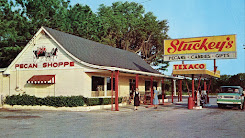
Hitting the road again on the morning of Day Two, we visited our share of Stuckey's, the granddaddy of roadside rest stops. Stuckey's, dating back to the 1930s, once boasted nearly 400 locations across 30 states. Over 4000 billboards nationwide announced the distances to the next store to weary travelers. It was a place to get gas, stretch your legs, visit a rest room of questionable cleanliness and purchase a variety of Southern-style treats like boiled peanuts and pecan log rolls. It was also a window into a culture that a Northerner who had never crossed the Mason-Dixon Line had ever experienced. The flagpole in the parking lot usually flew a large Confederate flag and among the hand fans, sunglasses and snow globes, one could easily find a selection of items depicting "playful" racist sentiment amid images of kerchief-wearing "Mammies" and sinewy, overall-clad African-American children eating watermelons. In 1984, still many years away from the disappearance of such items from Stuckey's shelves, Mrs. P and I marveled at their stock in uncomfortable silence.

Somewhere in North Carolina, we chanced upon our very first Cracker Barrel. We had passed several billboards promising an "old country store" experience, its message illustrated with the help of a friendly-looking country gentleman in a rocking chair leaning on — what else? — a cracker barrel. Up ahead, set back a bit from the six-lanes of I-95, was a rustic little building with a long front porch outfitted with a line of high-backed rocking chairs. Mrs. P veered the car onto the small service road that connected the highway to the parking lot. We parked, walked across the crunchy gravel that covered the lot and stepped up on the porch towards the big wooden entrance doors. Between a few of the rockers were cloth checkerboards on barrels and an array of red and black checkers in position and ready for a new game. The front doors opened to the sound of a tinkling bell, purposely placed to evoke visons of ol' Mr. Drucker or reliable Nels stationed behind the counter of Oleson's Mercantile. 

With beauty shots of fried chicken and fresh sunny-side up eggs splashed across forty-foot billboards, we were of the understanding that Cracker Barrel was a restaurant. But once inside, we were momentarily startled, believing we had mistakenly entered the annual Mayberry Church Bazaar, half expecting to find Aunt Bee and Clara Edwards duking it out over a box of Christmas decorations. Cracker Barrel offers the best of both worlds for the typical vacationer traveling by automobile. There's a roomful of pseudo-country crafts, knick-knacks and clothing along with a large selection of snacks, condiments, beverages and cast-iron vessels in which they can be prepared. Tucked in a nearly-obscured corner is the entrance to the actual restaurant — a large, open, plank-floored dining room with tables attended to by a battalion of gingham-and-denim dressed young ladies just trying get enough money to get through the next semester of college. 

Let me tell you something, as a person descended from the group of people who fought on the non-bigoted side of the Civil War, I was a wee bit uneasy meandering around the faux-homey displays in the Cracker Barrel retail area. As a person who was raised Jewish — albeit a very casual and minimally observant version of Judaism — my feeling of uneasiness was heightened. There was just something about the place that made me feel I didn't belong. From my standpoint, Cracker Barrel is not for everyone. Sure, on the surface, it appears very welcoming and very hospitable — a comforting oasis on the road to one's vacation destination. But, there's an underlying feeling of scrutiny and a palpable air of non-Heimisha that permeates Cracker Barrel. I can't quite explain it, but ask one of your Jewish friends (assuming you have at least one). They'll know what I'm talking about. They'll know that you shouldn't dare ask for a bagel to accompany your country breakfast plate. (As the kids say: "IYKYK.")

Over the years and through many journeys down I-95, my family and I stopped at Cracker Barrels. We noticed that locations began popping up more frequently and closer in proximity to one another. We even ate in Cracker Barrel's dining rooms one or two times, often finding it very difficult to find an entrée (or even a side order) that fit into the criteria of a family that keeps Kosher (like mine). A lot of Cracker Barrel's victual offerings are proudly, if not stealthily, cooked in or with some sort of fat rendered from an animal that doesn't possess a cloven hoof or chew its cud. (You have the internet. Google the "rules of kashrut" and settle back for a wild read.) Pancakes or eggs were a safe bet, but corn muffins and hash browns were inexplicably prepared with bacon fat. After a while, the Pincuses wised up and stopped elsewhere for meals along the 900+ mile trip. We still stopped at Cracker Barrels here and there, just not to eat.

Just last weekend, Mrs. P and I attended a collector show in Maryland, a couple of hours drive from our suburban Philadelphia home. The COVID-19 pandemic, coupled with some pressing family issues, have kept us grounded for the past few years... more specifically, keeping my wife from engaging in one of her favorite activities — road tripping. Mrs. Pincus loves to drive. Loves it! Almost as much as I hate driving. In our nearly forty years of marriage, we've driven to a lot of places. (Well, she's driven. I just sat in the passenger's seat and gazed out the window like a puppy.) But Mrs. P loves tooling along, window down, wind blowing, fiddling with the radio buttons and taking in the whole carefree experience. On our way home from Maryland, we found ourselves on familiar I-95 in the once-familiar position of looking for a place to have dinner... harkening back to those long-gone days of checking a AAA TripTik for rest stops. Of course, the TripTik has gone the way of the dinosaur in these instant gratification days of the internet. Now I just merely Googled "restaurants near me" and, with the mobile GPS coordinates emitted by my phone, the glorious internet guided us to a selection of chain and local restaurants available at the next exit. One of those places was a Cracker Barrel. Mrs. P lit up. "Hey, let's give Cracker Barrel a shot!" (We had briefly decided on Red Robin, but weren't committed.)

Mrs. Pincus steered the car off the highway and followed the posted directional signs to Cracker Barrel. A narrow road looped around the parking lot of a Hampton Inn where, nestled behind a bank of landscaped trees and bushes, was the familiar rustic porch of Cracker Barrel. The rocking chairs on the porch were now constructed with some poly-carbonite-neo-fiber-wood-like alternative, but their appearance brought back memories circa our honeymoon trip. We entered the building and were immediately transported back decades. The store stock was the same. Sure, things were a bit updated, but there were still plenty of knurled wood plaques with "WELCOME" painted in distressed pink letters. There were displays of smiling Christmas snowmen and rural-looking Halloween witches side-by-side. There was a toy section filled with quaint "Wooly Willys" and wooden trains, along with trendy electronic devices and Barbie-themed items. Near the dining room entrance, there was a large area with shelves full of candy and chips and unusual bottled sodas. Mrs. Pincus picked up a few candy packages in hopes of bringing back a little surprise for her parents. She began scanning the packages for a symbol indicating Kosher certification. (This has been a common practice for us. I hope you Googled  "rules of kashrut" like I suggested.) I told her not to bother. Even though we have entered the 21st century and more and more businesses are doing their very best to accommodate the needs of those with specific food aversions, allergies or dietary restrictions based on religious, philosophical or environmental beliefs, Cracker Barrel is still a Southern company with Southern values and, if it weren't for recently-passed laws, would still be flying the ol' Stars and Bars right below Old Glory on their flagpole.

We were seated in the restaurant by a very attentive young lady who handed us menus and returned quickly to fill our coffee mugs. I noticed that Cracker Barrel now offered Impossible™ sausage, the trendy new plant-based meat substitute, alongside their standard fare of pork sausage, pork bacon and pork pork. (Plant-based foods have been a boon for those who keep kosher [Mrs. P] and follow a vegetarian diet [me].) I remember when Cracker Barrel announced that they would be adding plant-based sausage to their menu. The uproar on social media was incredible. Folks (who I was surprised could operate something more complicated than a lawn mower) posted tweets and Facebook comments, expressing their anger with Cracker Barrel's decision. "How dare they buckle to the needs of these "woke" people!" "Keep this plant-based bullshit off the menu! I want my bacon!" "We don't need this crap on our menu! Vegetarians can eat somewhere else!" were just some of the disgruntled sentiment I read. I expected to see someone asking that string beans be removed from the menu, too, " 'cause I don't like string beans!" Cracker Barrel's regular customers are very protective of their beloved rest stop. They want to keep it free of infiltrators with their new-fangled, plant-based, progressive-thinking healthy food and all-inclusive ideals.

After dinner, we paid our check via a sophisticated-looking terminal at the front counter. With our credit card inserted into a slot beneath the tiny screen, we were offered the option to leave a tip in one of three "pre-figured-out for you" dollar amounts. The clientele, however, looked like they would be paying their bill by bartering with provisions from their dirt farm. On my way out the door, I passed a rack filled with CDs by classic country singers as well as Jason Aldeen. There may have been a Confederate flag rolled up in the corner.

Cracker Barrel is an interesting diversion from real life. Try the pancakes. You get your own little bottle of syrup...and maybe a judging glance, if you're lucky.

Y'all come back now, y'hear?

www.joshpincusiscrying.com

Sunday, May 14, 2023

go down moses

Well, we just wrapped up Passover a couple of weeks ago. While Passover is not my favorite holiday, I can safely say that Passover is not my favorite holiday.

Growing up in the Pincus house, Passover meant that a box of matzo joined the ubiquitous loaf of bread on the kitchen table. My mom bought a jar of gefilte fish and, over the course of eight days, consumed the contents of that jar herself. There was no way in hell my father was going to let a morsel of that stuff cross his meat-and-potatoes tempered lips. Passover or no Passover, tradition of thousands of years or no tradition of thousands of years, Harold Pincus didn't change his daily eating habits for no one — not even the God of Abraham. My brother ate those macaroons from a can and avoided the bread. I enjoyed the fried matzo that my mom prepared. I watched as much of the annual airing of The Ten Commandments on television as I could. I think I even went to a seder at an uncle's house when I was very young. We probably left when my father just about had enough. And that was my Passover.

Until I met my wife.

Mrs. Pincus came from a very traditional Jewish background. Very traditional. (To be honest, compared to the way the Pincus family celebrated Jewish holidays, Pope Francis came from a more traditional Jewish background.) Mrs. P's family went all out, especially for Passover. They cleaned the house. They changed their kitchen over to all Passover dishes and utensils. They "sold off" their chametz (food that is not kosher for Passover) and they staged an elaborate seder on the first night of Passover, with an encore performance on Night Two.

My mother-in-law prepared food from scratch that would last for the duration of the holiday. She made soups with hand-formed matzo balls. She made brust (brisket) and chicken and an array of side dishes, most of which contained some form of matzo My father-in-law prepared his own gefilte fish, grinding real fishy fish and shaping the concoction into little oblong footballs. There were boxes and assorted packages of baked goods from a special New York bakery that my in-laws would travel to and make purchases, not only for their family, but for the families of their fellow congregants at their synagogue. Passover was a big deal. It was all new to me. I participated out of respect to my wife and in-laws, but I wasn't a fan.

Soon, the Pincus family expanded by one. My son, who went all through Jewish day school, became an expert in all things Jewish and very well-versed in all Passover traditions, leading certain parts of the seder year after year. I proudly watched, but still remained nonplussed at the whole Passover thing. I didn't care for the food and I didn't care for the eight-day interruption in my daily routine. Surprisingly, I was looking at Passover the way my father looked at Passover.

It's funny how things change when you get old. Older! I mean older!

2023 marked the third consecutive year without a traditional seder at my in-law's house. This is due to several factors. In 2020, Passover came just weeks after the entire world was shut down by the uncertainty of a global pandemic. Families sequestered themselves from contact with other family members out of fear, out of safety and out of concern. Mrs. Pincus and I sat at our little kitchen counter and ate matzo. Mrs. P braved the looming cloud of COVID-19, donning a protective mask and making her trip to the supermarket as quick and efficient as possible. Under the circumstances, she bought jarred gefilte fish. Her father had given up the lengthy process of making his own and he certainly wasn't going to re-start the practice during a pandemic. At dinner time, Mrs. P fished (no pun intended) a piece of gefilte fish from the jar and plopped it down on a paper plate. I looked at it. Suddenly, a wave of adventure washed over me. "I'll take a piece of that.," I said... much to my wife's surprise.

This year for Passover, in an effort to be less like my father and more like... like.... a mensch, I ate gefilte fish again. A few times, even taking more than one piece at a time. Of course, I drown that little beige lump in a generous helping of electric purple horseradish-and-beet accompaniment. Y'know, if you cover anything with enough horseradish, it can actually be palatable... provided you like horseradish. And I do. And gefilte fish really isn't that bad. It's an acquired taste that I guess —over the years — I have acquired.

Every year, when I try something at Passover I never ate before, Mrs. P marvels and says: "Your mother would be proud."

Sunday, June 19, 2022

the hardest cut

Last week, a man — who some might label a local legend — passed away. As far as legends go, this man's status was pretty slim. By trade, he was a mohel, a person trained in performing circumcisions in the manner dictated by Jewish tradition,. One does not have to be a rabbi or have any sort of religious training whatsoever. All you need is to apprentice with an experienced mohel, and like any other trainee — watch and learn. This man was an eighth generation mohel, learning from his father, who learned from his father, who.... well, you get it. In the Philadelphia area, this man was the "go-to" mohel for decades. Thirty five years ago, he performed my son's circumcision. He performed countless circumcisions before that... and since. So, if you consider the top choice of mohel in a city of 206,000 Jews a legend, well I suppose he is a legend. But, you have to admit, it's pretty slim criteria. 

My son was born in August 1987. As per tradition, arrangements were made to have his brit milah eight days after his birth, where he would be welcomed in to the Covenant of yada yada yada. This man — the mohel — would be at our house bright and early to perform his little ritual before a houseful of my family and friends. Our kitchen counter was laden with bagel and cream cheese and whitefish salad and other components of a typical Jewish brunch — all lying in wait until after the ritual was over. At 9:30, a silver Jaguar pulled into our driveway behind my wife's car, A dapper-looking man with a gray goatee, dark Ray Bans and a leather jacket excised himself from the low driver's seat. He clutched a weathered leather case closed to his hip as he traversed my front porch and entered my house. He doffed his coat and stuffed his glasses in his breast pocket. He called my wife and I over to a corner of our dining room and briefly outlined the pending procedure. As he spoke, he unzipped his case and removed some fearsome-looking implements. My unsuspecting son was brought in and laid upon a thick, vinyl upholstered pad on our dining room table. (For those of you who may be wondering or have been recent dinner guests at our home, no... we no longer have that table.) My friend Scott, a recent medical school graduate and now in the throes of an internship at Temple Hospital, jockeyed for a front-and-center position. Most everyone else took a step backwards, some observing the procedure through fingers laced across their eyes. It was over before you knew it, its conclusion announced by a loud shriek from the "child of the hour." Soon, everyone was noshing and kibbitzing and schmoozing, including the mohel, who grabbed a bagel. He stuffed the circular bread into his jacket pocket and put an arm around my shoulder, whispering, "Mazel tov! That'll be $250." I wasn't sure I heard correctly. He repeated himself, just in case I didn't. Honestly, I had no idea how much this would cost. (In 1987, $250 was a lot of money! A lot! I can't imagine how much it costs today.) Bewildered, I dashed off a check and handed it over. The mohel thanked me, took a bite of bagel and told me he was off to another circumcision, the second of four that day. As he revved up his Jag, my friend Scott asked if the mohel did anything else for a living, implying that moheling was just a side hustle. I answered: "He pulled up in a Jaguar, took 250 bucks from me for twenty minutes work, got a free bagel and went off to do three more of these... and his day is over before noon. Why would he do anything else?

Years later, when my son entered high school, he became friendly with a classmate named Alex. Alex, as it turned out, was the mohel's son. Around this time, my wife's cousin gave birth to her first son. Of course, as every good Philadelphia Jew knows, the mohel had to be contacted. The morning of the bris, we gathered at my wife's cousin's house. I believe this was the first bris my son attended since his own. In came the mohel, with his Ray Bans and leather jacket, although his goatee had gotten considerably grayer. After a few preliminary words of explanation for the benefit of the uninitiated, the procedure commenced. My son watched... and winced. The next day at school, he spotted Alex and said: "You won't believe what I saw your dad do to a baby yesterday!" My son received an eyeroll as a reply.

Needless to say, the ninth generation of moheling will have to continue elsewhere. 

Sunday, April 11, 2021

why's everybody always pickin' on me

People compose yourselves. This is a bris. We are performing a bris here, not a burlesque show. This is not a school play! This is not a baggy pants farce! This is a bris. An ancient, sacred ceremony, symbolizing the covenant between God and Abraham... or something.
— "The Bris" Seinfeld, 1993
Remember that episode of Seinfeld? It was just one of a number of storylines on the long running comedy that poked fun at Jewish tradition. Show creators Jerry Seinfeld and Larry David were not especially observant as Jews growing up in Brooklyn, but they were keenly aware of the many rituals and foibles that "their people" displayed. Anti-Semitism was addressed in the episode where Jerry was labeled an "anti-dentite" based on his attitude towards his dentist. Hitler was hilariously mocked by Elaine's boss Mr. Pitt (as played to deadpan perfection by the late Ian Abercrombie) when he delivered a speech about Poland Springs water. The whole setting of Del Boca Vista, the fictitious, but all-too-real, Florida retirement community where Jerry's parents resided, could only have been imagined by someone with intimate insight into the real thing.

The episode "The Bris," first broadcast in October 1993, was unusual in its subject matter. The self-proclaimed "show about nothing" was actually about something. While Seinfeld sporadically included a smattering of Jewish references throughout its nine-season run, "The Bris" presented a scenario that most non-Jews would never get the opportunity to witness. The segment was replete with terms unfamiliar to most gentiles, like "mohel" and the word "bris" itself. Of course, its main goal was to be funny, but it managed to weave some of the actual parts of the ceremony into the narrative. Series co-star Jason Alexander later lamented that he didn't care for the child-hating aspect of the mohel character, but you gotta do what you can to be funny.

Well, I am very familiar with the liturgy of brit milah (ritual circumcision), having witnessed many, including one that was performed right in my own dining room, (and by "witnessed," I mean "turned away at the crucial moment, along with every other male in the room," with the exception of the mohel... I assume.) Every bris is nearly identical — a lot of explanation to the uninitiated, a lot of chanting and recitation in Hebrew, a certain amount of screaming and crying (some of it even from the baby), followed by the ever-present bagels-and-such spread, which is prevalent at most Jewish home-based ceremonies. Now, in these days of social distancing, a gathering such as a bris is subject to a different set of protocol. Yesterday, my wife and I attended one such bris using the modern miracle of the Zoom meeting. And this one had all the makings of a Seinfeld episode, circa 2021... but not for the reasons you might think.
The rabbi's wife at my brother-in-law's shul (a Yiddish word meaning "synagogue" that Jews like to use to make them feel more like Jews) had a baby last week and, as per tradition, he was to have a circumcision on the eighth day after his birth. A link to join a Zoom bris was sent out to members of his congregation, as well as friends and relatives across the country and those who made a small contribution in honor of the blessed event (that's where we fit in). Mrs. Pincus and I huddled around my computer screen about fifteen minutes prior to the appointed time, just to make sure all systems were working properly. Several other folks had the same idea. Soon little blocks were slowly populating my computer monitor, some with silent faces adjusting camera positions or some just staring blankly at us, waiting for this thing to begin and be over. Everyone's audio was automatically muted, as predetermined by the admin, in this case — the rabbi and new proud father. Mrs. P and I watched in amusement as folks got up from their desks and wandered out of the room. Others squinted, waiting for something to happen, as they ate from a plate placed just out of view of the camera. One little window displayed two curious little girls — one wearing glittery cat ears perched atop her head — peering into the camera as though they were observing some poor fellow who had fallen down a well.

And then Gary appeared.

As proclaimed by his on-screen name, Gary chose to view the upcoming bris via the technology afforded him by his iPad. From the angle in which we saw Gary, his iPad must have been laying flat on a desk or table and he appeared to be hovering above it. Instead of a familiar backdrop of a bookcase or a shelving unit filled with Judaica-heavy knick-knacks, Gary had only a blank ceiling behind him. Every so often, when he would consciously move the unit or accidentally bump the table, and we would catch a glimpse of a clock hanging on the wall. This would appear in the bottom portion of the screen because of the unnatural angle at which the iPad was situated. In addition to a splendid view of Gary's ceiling, we were also treated to a medical examination-quality perspective of Gary's nasal cavity. 

As the time clicked closer to the beginning of the bris, the rabbi popped in to say that the baby's fussing will cause an unavoidable delay. He promised to be back as soon as the "guest of honor" had calmed down. As consolation, those who logged in early were subjected to a lengthy display of Gary picking his nose. Extensively. In full view of the camera and a virtual roomful of eager — now disgusted — "guests." Gary showed no sign of slowing down. He dug and prodded and scratched and drilled. He poked and jabbed and excavated and plowed. I could not overt my eyes. I was rivetted, as though I was driving slowly past a a multi-car pile-up on the Expressway, hoping not to see any carnage, but secretly wishing the opposite. Except I had zero desire to see anything that Gary extracted from his nostrils.

Finally, the actual ceremony began. The rabbi offered a heartfelt "welcome" to all who joined, mentioning select few by name. He introduced the tradition of "the bris" by saying "you all know the story" — then he proceeded to tell the story. His wife briefly entered the frame and waved, then a committee of bearded, tallis-swathed men hijacked the action, chanting quickly in Hebrew and rocking their bodies in complementary rhythm. It didn't matter that the actual act of circumcision was performed off-screen, Gary was otherwise preoccupied

I could not tear myself away from Gary. And Gary could tear himself away from his nose. Gary was diligent, not letting some little bris interrupt him from the task at hand. A few times, Gary's screen upended — probably from an errant bump. For a fleeting moment, his little allotted rectangle resembled a hand-held camera scene from a late-era Friday the 13th sequel with blurred body parts being tossed about in dim lighting. Almost as quick, Gary righted his device and was back to "cleaning house" with nary a breather. Gary stood out among the sea of smiling faces across my monitor. But I could only focus on Gary. Could I be the only one who could see this?

Somewhere along the line, while my attention was, unfortunately, elsewhere, the ceremony ended in a hail of "mazal tov"s. The rabbi and his wife were beaming in their little cube at the center of the screen. Guests were merely gesturing applause since everyone was still muted. The rabbi thanked everyone for their attendance and promptly clicked his "Exit Meeting" button. His square disappeared. Gary stuck around for some further probiscal maintenance. Mrs. Pincus and I did not.

This, too, was not a school play! This, too, was not a baggy pants farce! I'm just not sure it was indeed a bris.

Sunday, March 28, 2021

all things must pass

Passover begins this weekend. You know when you watch Charlton Heston in The Ten Commandments and you think it's somehow connected to Easter, because — after all — ABC shows it every year around Easter time? Well, it's actually about Passover.

Passover is a time for renewal, as in an "out with the old, in with the new" sort-of fashion. As the tradition goes, all of the food you currently have in your house has to be consumed or disposed of prior to the start of Passover. Then, new food that is certified as "Kosher for Passover" is purchased and eaten during the eight days of the holiday. (They tell me it lasts eight days, but I'm convinced it rages on longer than that.) On the night before Passover begins, families stage a ritual "search for chametz" in their homes. Chametz is any food that is not deemed Kosher for Passover. As part of the tradition, a small amounts of chametz are placed around various rooms in the home. Then, a "search" is conducted using a pre-assembled "chametz kit," which includes:
  • a candle to light the way during the search (as it is performed with the lights out — oooh! spooky!)
  • a feather to "sweep" the chametz once it is located
  • a wooden spoon, which acts as a dustpan to catch the chametz once swept
  • a paper bag, to contain the chametz... sort of like a primitive version of the trap from Ghostbusters.
Some sort of appropriate prayer is recited prior to the search and at the conclusion. The sealed bag of collected chametz is placed by the front door and, the next morning, is taken to some community location (a synagogue or such) for — get this — burning. Years ago, when our son was younger and when I was much, much more observant in my faith, we would actively and sincerely reenact this tradition every year. My son and I, with yarmulkes perched atop our heads, would methodically move from room to room in our house. As a representation of the chametz in our house, I would leave little piles of cereal or crackers strategically placed in the rooms where we most likely ate food over the course of the past year. I would lead the way, illuminating our path with the lit candle. My son would wield the spoon and feather, dutifully sweeping up each discovery of chametz and insuring that each morsel made it into the gaping mouth of the paper bag. When our search was completed, we would gather in the kitchen where Mrs. Pincus would intone the magical words of prayer as I wrapped a rubber band around the paper bag as a final secure seal.

The next morning, we'd head over to my in-law's house, where my father-in-law would set up "Chametz Central" and the final leg of the ritual would commence. He'd drag out an age worn metal garbage can lid — rusty and discolored from years of chametz burning. I'm fairly sure this was the actual vessel in which Moses and his family burned their chametz before they headed out through the desert with those hunks of unleavened bread. Each of our families' bags were deposited in the center of the inverted lid. My father-in-law would douse the bags with way too much lighter fluid and — like a seasoned arsonist — he'd casually flick a lit match into the dead center. Then he'd say some different magic words of prayer and we'd watch the flames grow and rise and die down. Then, we'd go to our respective jobs and schools.

Over the years, my interest in organized religion has waned considerably. I don't attend any type of religious services and I don't care to participate in anything remotely religion-related. With our son now living in his own house, I reluctantly, though obligingly, agree to searching for chametz (out of respect for Mrs. P). I quickly rush through the process, but I will not attend the burning portion at my in-law's house. However, this year, Mrs. Pincus — who has clearly been corrupted by nearly four decades of exposure to the subversive ways of Josh Pincus — suggested a different commodity be substituted for our usual chametz-representing Cheerios... you I know, to shake things up. She suggested unpopped popcorn kernels. I immediately lit up, envisioning the scenario that would occur the next morning when my unsuspecting father-in-law tossed that match onto the fuel-soaked bags and the fire got going. We actually giggled at the possibly of injecting a little noisy surprise into an otherwise solemn ritual — and maybe even briefly rattling my usually pious and traditional father-in-law.

So, we searched for unpopped popcorn kernels sprinkled throughout our house. My wife said her little prayers and I snickered as I wound a rubber band around the paper bag.

The next morning, we arrived for the final steps of the chametz-search. We dropped our bag alongside my father-in-law's bagged spoils from his search the evening before. He squeezed out a few drops of lighter fluid across the tops of the bags and, after some initial difficultly, ignited the bags on the fifth match-striking attempt. At this point, I would like to report that, after an eerie quiet, our bag erupted in a hail of violent, uncontrolled explosions — spewing popcorn shrapnel in all directions from the raging flames. I'd like to report that my poor startled father-in-law was immediately taken aback in horror and alarm, as my wife and I mischievously cackled in delight.

I'd like to say all that, but I can't.

The popcorn had been sitting in our kitchen cupboard for a few years. It had no doubt lost whatever it is that makes popcorn pop. So, as the flames grew and our anticipation grew more — a single kernel emitted a single, feeble, debilitated pop. Actually, it didn't even warrant the word "pop" as a valid description. My wife and I exchanged disappointed looks. By this time, my father-in-law had already lost interest.

Happy Passover everyone. Maybe next year.
