Showing posts with label film. Show all posts

Sunday, March 8, 2026

here we are now, entertain us

I like to watch movies. I like to watch movies with my wife and I like to watch movies alone. Sometimes, I have to do both of those because I don't always share the same tastes in movies with my wife. Recently, I have watched a few recent releases that — in a million years — Mrs. Pincus would not have sat through. One was a fairly graphic horror movie. I know from past experience that Mrs. P has little tolerance for horror movies. I still remember her watching Creepshow through fingers protectively threaded across her eyes and asking how much longer will this go on. The recent movie I watched would have had her exiting the room after the opening scene. I watched another recent release that would not have held her interest at all. It was a very slow build-up until the story started to come together. So, I have — more or less — become the official movie screener for the Pincus household. I will chose a movie for the two of us to watch, based on whether or not Mrs. P will like it. I will happily admit that I'm not always right.

Recently, I suggested a made-for-television movie called A Carol for Another Christmas. It was originally broadcast in 1964 on ABC. It was only shown once until it resurfaced a few years ago on the  Turner Classic Movies network. I thought it was a good choice for us to watch. It was written by Rod Serling and Mrs. P is a long time fan of Twilight Zone. It featured well-known actors like Sterling Hayden, Ben Gazzara, Eve Marie Saint, Peter Sellers, Robert Shaw and Pat Hingle. So, we settled in to watch. It turned out to be a long-winded, smack-you-over-the-head, message-filled piece of anti-nuclear propaganda that was produced, in part, by the United Nations. It was a tedious, repetitive, preachy, self-righteous 84-minutes that seemed twice as long. As we watched, I could sense that Mrs. P was getting "antsy." Fifteen minutes in, her full attention was given to her cellphone. That evening's entertainment choice was a bust on my part. I vowed to be more discerning in future suggestions.

Last night, we interrupted our usual evening's viewing of cartoons (our cable provider recently began carrying MeTV Toons, a 24-hour network devoted to the cartoons of our youth) to watch a movie. I selected a movie that I remember watching years ago. I asked my wife if she had ever seen it. She was unsure. So, we watched.

The movie in question was a 1968 theatrical release called The Night They Raided Minsky's. It was an early production from the pre-All in the Family partnership of Norman Lear and Bud Yorkin. The film had a very interesting and chaotic journey to the big screen, even before a film frame of celluloid was shot. It was based on a 1960 novel about the bygone days of burlesque in New York City. Tony Curtis was originally cast in the lead, but friction over the script caused him to walk. A young Alan Alda was considered as a replacement, but he was locked into a role on Broadway. Jason Robards was tagged just a few weeks before shooting was to begin. Mickey Rooney, then Joel Grey, were pursued for the second lead, but other bookings prevented them from taking the role. British comedian Norman Wisdom was cast despite being relatively unknown to American audiences. Joey Faye, Eddie Lawrence, Dexter Maitland and Bert Lahr — all former burlesque performers — rounded out the cast. Lahr, however, was practically on his deathbed, have been diagnosed with terminal cancer just prior to production. The cast was supplemented by solid performances from Denholm Elliot, Joseph Wiseman, Harry Andrews, Forrest Tucker and Elliot Gould in his motion picture debut. At the forefront was the adorably waif-like Britt Ekland as the object of everyone's affection. William Friedkin, fresh off his directorial debut at the helm of Sonny & Cher's 1967 hippie indulgence Good Times (and several years away from The French Connection and The Exorcist) was tapped to direct. Friedkin, who shot forty hours of footage for the project, had a vision for the final product that differed from Lear's, Yorkin's and the "powers that be" at United Artists. After working — unsuccessfully — with respected film editor Ralph Rosenblum, Friedkin moved on to another project. He called The Night They Raided Minsky's "the biggest piece of crap he was ever involved with." Rosenblum took a full year to recut and reimagine the movie with no input from the director. He introduced period stock footage. He reshot some scenes with a body double substituting for Bert Lahr, who had died during production. Rosenblum's version — which Friedkin had nothing to do with — was released to surprisingly positive reviews. It boasted the biggest budget for a film shot in New York City at the time. Its paper-thin plot, continuity errors and seedy look are all forgivable, as The Night They Raided Minsky's offered a frozen snapshot of a bygone and nearly forgotten period of entertainment history. The film — a complete work of fiction — was a love letter to the bawdy side of vaudeville and — according to the opening narration — the origin of the strip tease.

Mrs. P and I watched The Night They Raided Minsky's. It was uneven. It was creepy. It was funny. It was enjoyable. The cast was stellar, if somewhat slightly above the sitcom-level script. The full-length classic burlesque skits that were showcased was like watching a documentary, sometimes overshadowing the main plot of the movie... whatever it was. There was a love triangle of sorts. There was a shifty plot to humiliate a staunch moral advocate. There was an overbearing gangster. There was an angry Amish patriarch searching for his wayward daughter. There was a lot going on and sometimes the story was interrupted for the sake of a barrage of risque jokes. Despite the spot-on performances from Norman Wisdom, Joseph Wiseman, Jason Robards and Britt Ekland, the true stars of The Night They Raided Minsky's were the ladies who formed the disinterested, going-through-the-motions chorus of the burlesque stage. Everything came to a head in a very raucous climax and a very sit-com-y ending. 

Ninety-eight minutes later, Mrs. P and I were entertained. And I don't think she looked at the clock once.

Well, maybe once.


I met Britt Elkand in 2016. She was very sweet.

Sunday, November 2, 2025

just another story

I love movies. Love 'em, I tells ya! I have favorites, just like you. Those movies that I'll watch over and over again. There are others that I am happy to have seen, but don't feel the need for a second viewing. Then there are those that I could have gone the rest of my life without seeing and things would have been just fine.

I tend to shy away from big Hollywood blockbusters that are overhyped and loved by the masses because the masses have been told to love them. I have never seen any of the films in the Matrix franchise. Same goes for the Fast and Furious and Mission: Impossible series. I saw the first three Star Wars movies (Chapters 4, 5 and 6, for those of you keeping score), but that's it. And — to be honest — I didn't really like those three. To tell the truth, I don't care much for science fiction or movies based on popular comic books. I have, however, seen several entries in the Superman canon, only because my wife is a long-time fan of The Man of Steel. And, against my better judgement, I have seen a few of the Batman films, having grown up on the campy 60s TVB series. After 1989's Batman starring Michael Keaton, I kind of lost interest. Christopher Nolan's resurrection with Christian Bale did nothing for me.

I have always loved the horror genre. In my youth, I was a fan of the classics from Universal Studios, including the original Frankenstein, Dracula and The Wolfman. The subsequent reboots of those titles... not so much. I don't like the whole slasher trend and even more so, the so-called "torture porn" and "body horror" films that seem more like endurance tests than forms of entertainment.

As far as films go, I like a good story first and foremost. It seems, sadly, that Hollywood is more interested in blowing stuff up than a well-conceived story. Convoluted premises and totally implausible scenarios are frustrating to me. Also, movies that are "lovingly shot" and move along at the pace of paint drying do not bring me enjoyment.

Recently, I stumbled upon two — two! — films that I thoroughly enjoyed. These films shared similar attributes. They each featured an ensemble cast that deftly brought the story and their characters to life. They felt like real people, living real lives. They offered a thoughtful peek into the lives of people that you and I could know. — just regular people experiencing regular situations in their regular lives. No explosions. No evil plots to take over the world. No diabolical schemes driven by revenge. No outlandishly intricate action that the perpetrators execute precisely the first time, achieving impossible results. No. None of that. As a matter of fact, if you ask me what these two movies are about, I'm not sure I could answer. They were just a small glimpse of the lives of people. Just people.

The first film is My First Mister, a 2001 release that served as the directorial debut (and, so far, only directorial effort) of actress Christine Lahti. It is a small movie that had limited release in its initial run. It stars Albert Brooks — this time just as an actor and not portraying a character in his own script — and Leelee Sobieski, a talented young actress, who has since left the acting business to focus on her family and budding art career. The two main characters are skillfully supported by the likes of Carol Kane, Michael McKean, John Goodman and Mary Kay Place. Brooks plays an irascible menswear salesman who strikes up an unlikely friendship with Sobieski's angst-filled goth teen. But, My First Mister is so much more than that. It's a study of humans — their actions, reactions and interactions. It's a sweet, sad, funny, poignant way to spend an hour and a half. The insightful script was written by Jill Franklyn, best known for penning the "Yada Yada" episode of Seinfeld and the single season black comedy Gravity. The performances were spot on, as was the sharply accurate dialog. 

The second movie is The Station Agent, a 2003 film, marking another directorial debut, this one for actor/screenwriter Tom McCarthy (no, not the announcer for the Philadelphia Phillies). A dozen years later, McCarthy would win an Oscar for his screenplay for Spotlight, which he also directed and which won the 2016 Academy Award for Best Picture. What brought me to The Station Agent was McCarthy also co-wrote the screenplay for the Disney animated feature Up. The Station Agent, like My First Mister, is a little, unpretentious film that offers a candid peek into the lives of ordinary people and their ordinary lives. An early entry into his huge and celebrated body of work, the film stars Peter Dinklage as a quiet man who just wants to be left alone. His co-star, the versatile Bobby Cannavale, is a gregarious hot dog vendor who doesn't want to leave poor Peter alone. Filling out this unexpected trio is Patricia Clarkson as a mentally-preoccupied artist dealing with her own internal and external issues. Michelle Williams, John Slattery and the delightfully deadpan Raven Goodwin offer suitably realistic supporting characters. The story unfolds slowly and purposely, allowing the actors to fully flesh out their respective roles and create believable, relatable and emotion-filled people, not just actors reading line that were written for them to recite. It's funny and sad, joyful and nerve-wracking, sweet and touching. The plot of The Staiton Agent is ancillary. The real focus is the characters and how they are brought to life and how they evolve, thanks to the talents of three (and more) adept and very well-cast actors. (Screenwriter/director McCarthy noted that he wrote the characters with Dinklage, Cannavale and Clarkson in mind.)

I don't recommend movies. I don't know your particular taste in movies. I don't know if you'll like a particular film. I do know that I liked — really likedMy First Mister and The Station Agent. You might, too. But, you might not. There are no explosions or car chases or monsters or space ships. Just some solid acting and solid writing. 

I liked them. You? You're on your own.

Sunday, June 29, 2025

hooray for hollywood

I love movies and stories from the Golden Age of Hollywood. I love the glamor and glitz. I love the bigger-than-life personas. I love the behind-the-scenes dirt and gossip. There is just something so, appealing, so compelling and so reviling about the stars, the movies and the lore of the movie business from the 1930s until roughly the early 1960s.

I especially love the dark, seedy underside of Hollywood. That's where the real fun is. Scandals in Hollywood are nothing new. Lurid tales of double-crossing, abuse of power and false promises go back to the first time a strip of film passed though a flickering light and was projected on a screen. One of the best accounts of true Hollywood lore — in my worthless opinion — is Nathanael West's 1939 novel The Day of the Locust. A flop in its initial release, The Day of the Locust gained universal praise a decade after its first publication. Since the 1950s, the novel has appeared on numerous "required reading" lists and "best novels of the 20th century" compilations. Sadly, Nathanael West was killed in a car wreck just eighteen months after its publication.

The Day of the Locust is a dirty story of dirty people in a dirty industry. Thirty-six years after publication of the novel, Academy Award-winning director John Schlesinger brought the story to the big screen.

Although I loved the book so much, I never saw the movie until yesterday.... and what a movie it was.

The film version of The Day of the Locust stars young and versatile William Atherton in just his second starring role. He plays the main protagonist, aspiring art director Tod Hackett. His role is ably supported by a cast familiar to avid viewers of 70s movies and television. The characters from the book were thoughtfully cast, not just plopping the "flavor of the week" into a role, as is so often done in today's film offerings. The criminally underrated Karen Black plays wanna-be starlet Faye Greener. Her father, washed-up third-rate vaudeville clown Harry Greener is chillingly portrayed by Burgess Meredith. And, then there's the always capable Donald Sutherland as bashful, naïve Homer Simpson (no reference to the cartoon character — just pure coincidence), who gets top billing, despite not appearing until nearly forty minutes into the film. Also along for the ride are Jackie Earle Haley as an obnoxious child star, Gloria LeRoy as his overbearing mother, Bo Hopkins as a scummy Western star, Billy Barty, as Abe Kusich, Tod's cantankerous neighbor (and one of the film's most unsettling performances), John Hillerman and Richard Dysart as shifty movie studio executives, Paul Jabara as a nightclub drag queen and a surprising Natalie Schafer as (of all things) a whorehouse madam. I also spotted Nita Talbot, Robert Pine, Dennis Dugan and Jerry Fogel in small roles. The whole ensemble plays each individual part to its harrowing and pitiful hilt. The sets are vintage and the scenes are slightly tinted in a sepia hue, giving an air of authenticity of the era.

But, be warned. This is no love letter to Hollywood. On the contrary, glamor and glory takes a back seat. This is a sick, sleazy, sordid tale of lowlifes, broken dreams, lofty delusions, shallow personalities, sexual escapades, entitlement, disregard for humankind, arrogance and contempt... and a little bloody cock fighting thrown in for good measure. The final scene — which seems to go on and on long enough to make sure every gut is properly wrenched — will haunt you for days. It is visually unforgettable and perfectly illustrates the climactic nightmarish scenario as described in the book. It is brutal, disturbing and, at the same time, poignant and tragic. Film reviewer Lee Gambin called The Day of the Locust a "non-horror film that is secretly a horror film."

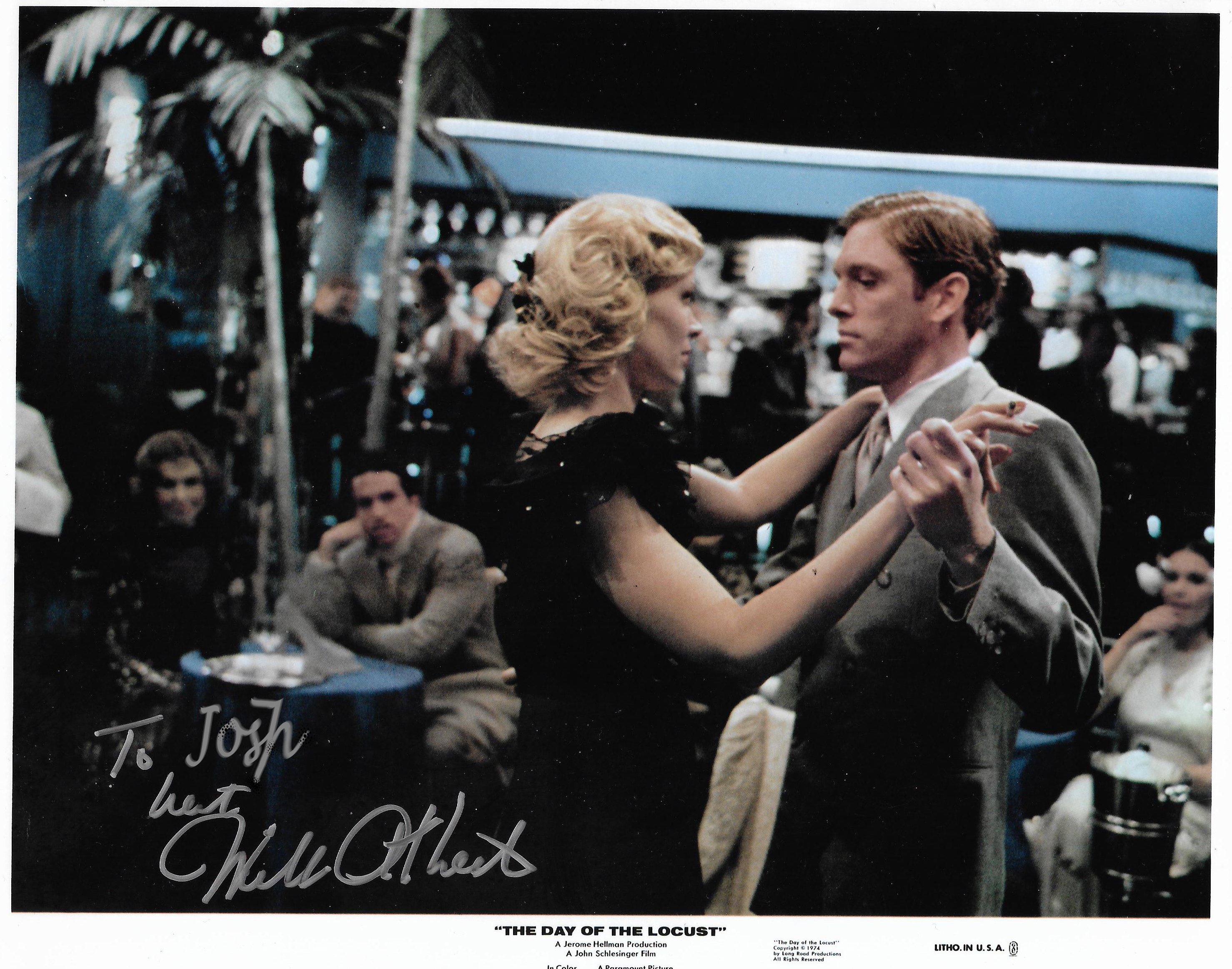
I met William Atherton at a horror-themed celebrity autograph show several years ago. Known mostly for his later career roles in Ghostbusters, Die Hard and countless other movies and television shows, I caught William off-guard when I asked if he had any stills from The Day of the Locust. He laughed and leaned in close to me so as not to let the other attendees — some dressed as Freddy Krueger and Jason Voorhees — hear what he was about to say. He whispered, "Nobody here has seen The Day of the Locust." as he gestured toward the costumed occupants of the room. Then he reached under his table to retrieve a briefcase from which he produced a single promo shot of him dancing with a blond-wigged Karen Black. He graciously inscribed the photo and even posed for a picture with me. I shook his hand and thanked him. He smiled and said, "That was a great movie and a great experience filming it."

It was a great experience watching it, too. Take that as a warning.

Sunday, May 11, 2025

the candyman can

This story previously appeared on my illustration blog.

For many years, I collected autographed photos of celebrities. “Celebrities,” I will admit, is a relative term and can only be defined as “someone who more people have heard of than have heard of me.” I obtained a good portion of my collection by attending local collector shows and conventions where promoters would gather together a sampling of celebrities from all levels of fame. I have met Oscar winners and I have met folks whose claim to fame was their appearance in a single —but iconic — film. (I’m looking at you, Danny Lloyd!) 
 
In early 2006, my son and I went to a horror movie convention in nearby Cherry Hill, New Jersey. We had been to this show several times over the years and I had met celebrities, engaged in lively conversation and purchased an autographed photo at the conclusion of our brief encounters. I don’t consider myself particularly “star struck.” My conversations with “celebrities” have purposely been about things other than the role for which they are best known. Over the years, I have spoken with Curtis Armstrong (of Revenge of the Nerds fame) about our shared admiration for singer-songwriter Harry Nilsson. I talked to the lovely Adrienne Barbeau about her long-running role in the touring company of the musical Pippin. I had a great conversation about California baseball with the late Jerry Maren, best known as the Lollipop Guild Munchkin who hands an oversized all-day sucker to Judy Garland in the classic The Wizard of Oz

This particular 2006 show was one of the first — if not the first — to feature actor Tony Todd and he appeared to be eager to meet his fans. Famous among horror movie aficionados as the malevolent “Daniel Robitaille,” the title antagonist in The Candyman series of films, Tony appeared in a number of non-horror productions before his first foray into the genre in the early 90s. Since then, he has been in and out of the horror realm, including stints on Law & Order, Murder She Wrote and multiple appearances in the Star Trek universe. Of course, horror films were Tony’s “bread and butter,” playing “The Candyman” in the original film, its two sequels and reprising the character in a 2021 reboot. He was also featured in the Final Destination film franchise, appearing in four of the six films as the mysterious “William Bludworth,” a funeral director with an intimate relationship with Death incarnate. But, Tony was a working actor and, not wishing to be pigeonholed, he took roles in the teen drama Riverdale and on the popular soap opera The Young and The Restless. He also lent his distinctively rich baritone to video games.

Unfortunately, a lot of attendees at these horror conventions have a difficult time separating the actor from the character. Tony, an imposing figure at 6 feet 5 inches, stood behind a table laden with glossy photos chronicling his career. He had a wide and welcoming smile on his face. Just behind him, a young man (later identified as Tony’s son), disinterested in the surroundings, busied himself with a hand-held video game. My son and I joined the queue to meet Tony. We were just behind a fidgety young lady. A series of belts and straps and buckles secured her tight-fitting leather garb to her person. Her jet black hair was highlighted with blood-red streaks. When she turned her head slightly to survey the room, I saw that her face was covered in white pancake make-up, accented with coal-black eyeshadow and color-coordinated lipstick. Without passing judgement, she cut a pretty frightening vision — even for a horror convention.

The line moved forward as each fan finished their interaction with Tony. The young lady in front of us was next. She approached the table and produced a large book, soon revealed to be a photo album. She opened the book and loudly began to spew a soliloquy about “The Candyman” to Tony. She was animated and passionate in her delivery, pointing out gory still photos in her book as she explained — in detail — her tale of Tony’s movie character, as though “The Candyman” was a real entity and Tony was The Candyman. As she continued, the smile disappeared from Tony’s face, replaced by a pained grimace. A thin sweat broke out on Tony’s forehead and he dabbed his brow with a tissue. His eyes widened slightly, as he tried to make some sense out of this… this… woman and her apparent delusions. A few times, he quietly interjected, “Um, thank you. You know, I’m just an actor,” but she would hear nothing of it. She plowed right over his words with more specifics of her “Candyman” manifesto. Finally, she selected a photograph from Tony’s available offerings and requested an autograph. After a quick exchange of cash, she closed her book, bowed her head and slunk away.

My son and I were next and we approached Tony’s table. We both greeted him, but were interrupted. A visibly shaken Tony Todd raised the index finger on his massive right hand and said, “Hi guys. Can you give me just a minute?” We both said, “Sure!” as we motioned obligingly with our open hands. Tony stepped back. He grabbed a bottle of water and pressed its cooling surface against his forehead. He lowered himself into a folding chair, twisted off the cap off the water bottle and took a long and calming swallow. He hung his head for a minute or two. His son put down his game and slung a comforting arm around his father’s shoulders. Soon Tony returned to us, slightly refreshed but still exhibiting the lingering effects of his previous fan encounter. We insisted to him that he get his bearings and we would wait until he felt better. The smile returned to his face when he realized that we were not going to accost him like the girl in leather.

We made no comment about the young lady before us, but he did. He questioned, rhetorically, “What was that?” My son and I shrugged and laughed. Tony was now warm, personable and humble. He became talkative and we discussed his other, non-horror roles. He signed a photo from his appearance on an episode of Smallville for me. My son and I each shook his hand and he thanked us for coming and especially thanked us for our patience. He even posed for a photo with my son.

In subsequent years, Tony became a staple at horror conventions. He evidently became accustomed to his eclectic fan base and the possibility of facing an “intense” fan. Tony passed away in November 2024 at the age of 69. 

He was a nice guy.

Tony and my son, 2006

Sunday, October 6, 2024

monster mash

I love horror movies. Or rather.... I loved horror movies. Frankenstein, Dracula, The Wolf Man, The Mummy... all of them. I watched them as a kid on my family's black-and-white TV on Saturday afternoons. They were campy and creepy at the same time. Since most of them were made in the 40s, they all had this strange — yet endearing — quality. Like the actors knew they were in a movie and were delivering scripted lines. It was like watching a play. It made things fun and not too scary. 

My love of horror movies progressed to the low-budget camp of the 1950s with beings from outer space and teenage werewolves. The acting was bad. The make-up was bad. The special effects were amateurish. But I loved them just the same. In some of the Japanese imports of the late 50s and early 60s, I swear I could see the metal pull of a zipper at the base of Godzilla's neck and he tore down an obviously miniature elevated train set in a faux downtown Tokyo.

The 60s, however, brought the real horror. England's notorious Hammer Studios offered garish takes on classic tales. Under the capable lead of Christopher Lee, Dracula, Prince of Darkness splashed vivid red blood across  the screen at a Saturday afternoon matinee, the likes of which I had never seen before. On television, I cowered with my mom as we watched the shadow of Norman Bates slash poor Marion Crane to bits in her shower in Psycho. I still maintain that Psycho is among the scariest movies I have even seen.

Of course, horror films grew more provocative and more daring and more bloody as directors pushed their limits and audiences demanded more. So-called "slasher films" became the norm with Halloween and Friday the 13th and A Nightmare of Elm Street (and all of their imitators) monopolizing theatres. Anti-heroes Freddy Krueger and Jason Voorhees and Michael Myers became icons, beloved among horror movie fans. I enjoyed the initial entries into these long-running (and lucrative) film franchises, but I lost interest after the umpteenth sequel presented essentially a retelling of the original movie.

I like an interesting and clever story. That grabs my attention. I don't care to see someone getting their limbs slowly separated from their torso by a crazed madman with unexplained super-human strength and an even less concise non-sensical backstory. The current trends in horror movies tend to present a skimpy outline of a plot and rely more heavily on overly gory, in-your-face exercise in torture, sadism and suffering.

Years ago, I saw a movie called Hostel. Actually, I saw part of a movie called Hostel. I was only able to stick with it until a man was strapped into a chair and various parts of his body were removed by a masked man wielding a power saw. I don't know how Hostel ended and I really don't care. Hostel, no thanks to me, was very popular. It spawned sequels and copycats — none of which I have seen or have any intention of seeing.

There have been a few recent horror movies I have enjoyed. The Ring was clever. I didn't find it particularly scary, but I appreciated the intelligent story telling. Silence of the Lambs, if that can even be considered a "horror" movie, was taut and spine-tingling, another example of a good story being executed by good actors. Even the Japanese import Audition with its hard-to-watch climax, was well-done and suspenseful in its presentation.

It seems that today's horror movie lover is not particularly discerning. Every new release (and there are a lot of 'em) boasts a similar synopsis as other recent films. A mysterious killer that kills for the sake of killing. A variety of killing methods each designed to produce the most blood, viscera and humiliation of the victim. Overly and gratuitously explicit scenes unfairly and disturbingly equating sex with mutilation. I read a capsulized plot of a recent horror "hit" called Terrifier about a murderous clown named "Art." Art seems to have joined, if not overtaken, the ranks of Freddy and Jason as the new slasher icon. The plot was nauseating, as were the similar plots of Terrifier's two sequels. I have no plans to see Terrifier, Terrifier 2 or Terrifier 3 (when it's released in early October). As long as all the right boxes are checked, the film should do well.

I just want a good old-fashioned horror movie with a monster and a good story and good acting and not a reservoir's worth of blood and guts.

Is that too much to ask?

Sunday, October 31, 2021

i've just seen a face

This is Daniel Roebuck. He's an actor. A pretty busy actor, as a matter of fact. You know him. He's that guy from that thing... you know. Actually, IMDB (the invaluable Internet Movie Database) lists him with over 250 acting credits, not to mention his numerous other credits as director, producer, writer and "special thanks." Here's a story about when I met Daniel... who is a really nice and gracious guy, to boot.

My in-laws owned and operated a store in a once-thriving farmers market just outside of Philadelphia. By the time they became my in-laws, the store was well into its fifth year of business. (Side note: my father-in-law opened this store as a stopgap while his primary business — a popular hardware store — was rebuilt after a devastating fire.) The store in the farmers market — Larry's Hardware — became a well-known "destination" as my wife and my mother-in-law brought in more "pop culture" merchandise, shoving aside precious shelf space once occupied by hammers, trowels and boxes of nails. 

I began working for my in-laws by the time my soon-to-be wife and I had our third date. I worked every weekend while I diligently sought a job in my chosen profession — graphic design. Even after I secured many a position in the design field, I still found myself stocking shelves and applying price tags to various items each and every Saturday from early in the morning until late at night. On Fridays, I was at my regular job, but Saturday was "Larry's Hardware" day for me. My wife, however, worked both days. When our son was born, Fridays were the times I spent with him while Mrs. P worked late. After putting him to bed, I would try my darndest to stay up until Mrs. Pincus got home. Sometimes, I didn't make it and I was often jolted awake by the sound of a key turning in the front-door lock. The TV was showing something that I don't remember watching. We'd go to bed to get a little rest before tackling a marathon Saturday at Larry's.

One particular Friday, I was watching a movie that I had never seen before. It was called River's Edge, a 1986 independent effort from director Tim Hunter, who went on to helm a lot of episodic TV, including Twin Peaks, Mad Men and the recent Hannibal. River's Edge is a dark, disturbing tale featuring a quirky cast of actors with a young Keanu Reeves at the forefront. I watched the film, admittedly dozing on and off as the hour got later. When Mrs. P got home, we talked a bit. She told me about some regularly-occuring incidents at the store and we headed off to bed.

The next day, I caught myself dozing off while sitting at the unusually not-busy cash register. I glanced over at one of the aisles — ten or so feet away — and I saw my wife talking to a customer. He was a man about my age. He sort of looked familiar, but I couldn't quite place him. I stared at this man as my wife talked, gesturing to some items on a shelf, although they were too far away for me to hear actual details of their conversation. Where do I know this guy from? was going over and over in my head. Finally, it hit me... I think. I got up and walked over to them. At first, I didn't interrupt them and the man smiled and nodded at me. I couldn't hold back any longer.

"Do I know you from coming into the store," I began, "or do I know you because I saw you kill your girlfriend in River's Edge last night?"

He wasn't even taken aback by my accusation. As a matter of fact, he laughed. Loudly. And so did my wife. Through her laughter, she explained that she just had a nearly identical exchange with this man.

"I asked," she said, "do I know you from coming into the store or because I saw you in an episode of Lois & Clark: The New Adventures of Superman?"

Daniel in Lois & Clark and River's Edge
The man, as we soon found out, was Daniel Roebuck. Daniel, a native a nearby Bethlehem, Pennsylvania, explained that he has been coming to this farmers market since he was a child. Now that he lives in California, he makes sure that it's one of his stops when he comes in to visit family. As we continued our conversation, we heard customers whispering and pointing at Daniel. We heard things like "That's Cody Bank's father!" referring to his role in a popular kid's film franchise and "There's the guy from Lost!," recalling his role of the notorious "Dr. Leslie Arzt," who blew himself up in a memorable sequence in the cult series. Other folks remembered other times they've seen Daniel Roebuck flash across their TVs or the big screen during an evening at the movies. After all, he's been in a lot, working alongside some of Hollywood's biggest names (Tommy Lee Jones in The Fugitive comes to mind), as well as being cast as a regular in the TV series Matlock and Nash Bridges. Horror films seem to be Daniel's bread and butter, appearing in a number of shockers with both big and small budgets. Daniel briefly paused our conversation to run out to his car to retrieve a photo album (this was before such a collection could be conveniently stored on one's phone) displaying his vast accumulation of horror movie memorabilia. He also inscribed a glossy, black & white headshot of himself to my wife and me. He actually purchased a few horror-related items to add to his collection, thanked us and exited into the busy main aisle of the market — where more people rattled off some of Daniel's past roles in somewhat hushed tones.

Daniel as Grandpa
From that point forward, we saw Daniel Roebuck in everything! New shows, old shows that we've seen a zillion times, but just now noticed an appearance by our new friend. He's been in a slew of comedies, dramas and anthologies. He was even in a late-season episode of Love Boat... (but who hasn't?) He played Jay Leno in a made-for-television movie about the late-night talk show rivalries. He played Garry Marshall in a TV biopic about Robin Williams. He's been featured in small roles in several of rocker-turned-filmmaker Rob Zombie's productions. As a matter of fact, Daniel landed the plum role of "Grandpa Munster" in Zombie's upcoming take on the classic TV sitcom.

Daniel popped into the store a few more times before its permanent closing in 2007. I have contacted him through various social media platforms, and after relating the story you just read, Daniel confirmed the episode and told how it still makes him laugh. He's a good guy.

If you didn't know his name before, you do now. And, just like us, you will now spot him in everything.

Sunday, May 17, 2020

celluloid heroes

I have been watching Turner Classic Movies pretty much since its inception in 1994. On April 14 of that year, Turner Classic Movies (TCM) broadcast the 1939 epic Gone with the Wind as a fitting debut into the world of classic cinema. From that point forward, the cable channel has shown thousands of Hollywood's beloved films, as well as numerous examples of forgotten features. Of course, there are films that enjoy regular showings, based on perennial popularity and fan feedback. Stand-bys like Casablanca, Some Like It Hot and Citizen Kane are shown often. Very often. Popular actors are seen in some of their popular and less-than-popular films, offering viewers an interesting glimpse into the high and lows of a particular performer's career.

What is intriguing about TCM is how many young fans are regular watchers. Considering the overwhelming majority of the films they show are from before 1955, you'd think there would be exclusive appeal to those who are more than a few years into collecting Social Security. But that, apparently, is not true. There are an awful lot of fans that are many years my junior. (I am almost 59.) They are passionate about films that were produced when their grandparents were kids. They are enamored by actors who passed away decades before they entered kindergarten. 

As it gained popularity, TCM began to branch out. In 2010, the first annual TCM Film Festival was presented in Hollywood. The four-day event was hosted by Grauman's Chinese Theater and Grauman's Egyptian Theater, where some of the most-beloved of Hollywood's films were screened for attendees as though it was a religious service. The event drew more and more folks with each subsequent year. During each year's festivities, attendees were interviewed. They were usually dressed in some period clothing that reflected their favorite era of cinema. Twenty-somethings sporting styles that predated their parents presented an interesting, if not anachronistic picture. These fans gushed with delight as they spoke about movies — all movies — like they were their children. Not just the famous movies, but many obscure films starring long-forgotten actors. Actually,  it seemed like they loved every movie, as long as TCM deemed it "classic".... or at least "old."

I love movies and I love interesting tidbits about movies, but I wouldn't classify myself as a "film buff." There are a lot of famous movies that I haven't seen and there are a lot of famous movies that I have seen but don't like. And while I'm "true confessing," there are some very beloved actors that I don't care for at all. A majority of TCM devotees treat all movies from the so-called "Golden Age of Hollywood" as indisputably perfect and required viewing for everyone. And everyone must love each and every one of them.

Recently, I watched three movies on TCM. I came to these movies in different ways, including indirect recommendations and "why have I never seen this?" All three star famous actors, but not necessarily their most famous role. The first was The Hatchet Man, a 1932 pre-Hays Code film. The Hatchet Man is a cringe-worthy seventy-five minutes that shows Hollywood at its racist and demeaning best. It stars Edward G. Robinson, fresh from his star-making turn in the gangster tale Little Caesar. The cast also features 19-year-old Loretta Young and a slew of English actors. The problem is that The Hatchet Man is a story about the Chinese community in San Francisco. While there are plenty of Asian extras roaming the streets, all of the principal roles are played by non-Asian actors in exaggerated make-up and costuming, spouting lines peppered with alleged "ancient Chinese philosophies" in preposterous broken English. The film also features the uncredited Toshia Mori (who is Japanese) as Robinson's Chinese secretary. She is the lone Asian in the cast with a speaking part, albeit a small one. Unfortunately, she is the target of a remark that is both racist and misogynistic in the same sentence. The interesting, sometimes brutal, story sadly takes a backseat to the blatant bigotry. Hollywood viewed Asian culture as a mystic novelty, an attitude it was unable to shake until.... well.... never. I found this film difficult to watch. While the acting was good, the story was thin and clunky in its telling.

A few days later, I watched the 1949 classic film noir The Third Man. I had heard great things about this movie and I wondered why it took me so long to see it. The Third Man consistently shows up on many critic's "greatest" lists, topping the British Film Institute's list of the "Greatest British Film of All Time." That is a pretty big deal. The film stars craggy Joseph Cotton as an American writer who arrives in post-war Vienna to meet his friend, the mysterious Harry Lime. While ringing the bell at Lime's apartment, he is informed that his friend is dead. This unfolds in the first five minutes. A jarring set-up that lays the foundation for what promises to be a wild ride. It is not. It is standard cloak and dagger that has been parodied a zillion times. The action is packed with knowing glances, shadowy figures, two-timing allies and abrupt, unexplained and unnatural changes in personalities. Plus there's a surprise that you can see coming a mile away. Director Carol Reed was obviously influenced by German expressionists, as the cinematography copies The Cabinet of Dr. Caligari as though it was shot with a piece of carbon paper behind it. The "look" of the film seemed more important than the story. At the film's conclusion, I honestly felt cheated.

Finally, I watched Ace in the Hole, a 1951 gritty Kirk Douglas vehicle that was Billy Wilder's first foray as writer, producer and director. This film was a mess in its initial release. At the last minute, the studio changed the title to The Big Carnival without consulting Wilder. The advertising poster is very misleading in its depiction of Kirk Douglas being trapped and in danger. He is not. That is apparent almost immediately,  so that's not a spoiler. Just after its release, Wilder was sued by a screenwriter for plagiarism. All that.... and it bombed at the box office. The story is a none-too-flattering account of media sensationalism and manipulative greed. Douglas is slimy and arrogant and he chews up every last bit of scenery. Co-star Jan Sterling is a stereotypical Hollywood "dame," a one-dimensional, underdeveloped character just there for the men to bounce lines (and slaps) off of. The rest of the cast are stock characters — the unflinching newspaper publisher, the bright-eyed eager photographer, the dim-witted common people. Six years after this movie, screenwriter Budd Schulberg would pen A Face in the Crowd. It is a much better, much darker, much more subtle presentation of essentially the same concept. I actually fell asleep a few times while watching Ace in the Hole, but I found I really missed nothing. That speaks volumes in the way of film editing.

When I talk to people about movies, I am enthusiastic about the ones I like. But, I will recommended films only if I think a particular person will like a particular movie. I don't say "You'll like this!" just because I like it.. However, some TCM fans and those who fancy themselves "film buffs" seem to like every movie they see... even if they don't really like them. They just think they're supposed to like them. I won't criticize you if you don't like a film that I like. That doesn't mean the movie is bad. It just means that we don't share the same opinion on every movie. With that thought fresh in our minds...

Although I won't make any friends with this admission, I will continue my confession. Two of the films I alluded to earlier — Casablanca and Some Like It Hot — are not my favorites. I have watched them both and I don't like either one. I am not a fan of Marilyn Monroe or any of James Dean's movies either.

Oh and I've never seen any sequel to Rocky or The Godfather. Can we still be friends?

www.joshpincusiscrying.com

Sunday, February 10, 2019

mary, mary

In December, with a house full of out-of-town guests, Mrs. Pincus and I were unable to fulfill our Christmas tradition of going to the movies followed by a dinner of Chinese food. We did, however, make it down to our son's house to feed his cat while he and his girlfriend celebrated the holiday with her family. But, alas, we missed our chance to see the highly-touted and highly-anticipated sequel to Walt Disney's 1964 Oscar-winning film Mary Poppins.

Until last night.

Nearly two months after its release, and with most of the excitement passed, my wife and I ventured out on a weeknight to see the film. We were enticed by an offer of five dollar admission — something we just couldn't turn down. When we arrived at the theater, it seemed that a lot of folks are not swayed by admission prices knocked down to below half off. The place was empty. That's not a compliant. Actually, that's a preference.

In 1964, my Aunt Clara took me to my first movie in a theater... and that movie was Mary Poppins. I loved it. It was bright and colorful, filled with cheerful songs and funny characters. Although I  was 3 years old, I actually remember standing up in my seat and clapping. In subsequent years, I watched Mary Poppins on television and later on a video tape that I purchased. I knew every scene and every song. My wife and I watched it with our son, who came to love it as much as we loved it. It was a bonafide, multi-generational family favorite.

So, when I first heard about the proposal of a sequel to Mary Poppins, I was very, very skeptical. Over fifty years had passed since the beloved original film. Many of the original cast members were too old to reprise their roles. Others were retired from acting while others were deceased. Of course, the new film would be recast. A new story would have to be written. And, with one of the celebrated Sherman brothers — the original's prolific composers — gone, recreating those infectious tunes would be a tall order.

When our opportunity to see Mary Poppins Returns at Christmas did not arise, I wasn't really that disappointed. I really didn't want to see it. I feared that it would tarnish the sparkling memories of the stellar original. But, when a five dollar admission to the movies presents itself, you don't think twice.

At the theater, Mrs. P and I sat through a number of trailers for forgettable films we decided we have no intention of seeing... not even when they are available on Netflix. Then the sparsely-occupied auditorium darkened and the familiar Disney Studio "castle" insignia filled the giant screen. 

I am happy to report that Mrs. P and I were held spellbound for the next 130 minutes. I wanted to dislike Mary Poppins Returns. I really did. But I couldn't. It was irresistible. It was a love letter to the original, loaded with nods and winks and subtle references. It was perfectly cast with the unflappable Emily Blunt capably filling the poised shoes of Oscar winner Dame Julie Andrews. Fresh from Broadway and settling nicely into his role as cheeky "Jack the Lamp Lighter" was the positively magical Lin-Manuel Miranda, whose put-on British accent wasn't nearly as distracting as Dick Van Dyke's attempt 54 years earlier. The supporting cast was spit-spot on. The sets were beautiful. The direction was snappy. The choreography was inspired (well, inspired by the original). The songs were jubilant when they had to be and sad when that was a requirement. Even the animation sequences were artistic homages to the style and characters of a Disney that wasn't out to sell you a time-share.

I seem to be gushing and you seem to waiting for the other shoe to drop. Sorry to disappoint, but not this time. I genuinely loved this movie. No snide remarks. No sarcastic asides.

No spoonful of sugar needed.


Sunday, November 18, 2018

it's beginning to look a lot like christmas

Here it is, the week of Thanksgiving and The Hallmark Channel is deep in the throes of its annual Christmas celebration. 

In 2001, greeting card giant Hallmark decided to enter the cable television business. The fledgling network continuously gained viewers with its decidedly "family-oriented" programming. As of 2015, Hallmark Channel reaches approximately 73% of homes that own at least one television. Their programs are definitely skewed to lure viewers away from the Lifetime and the OWN Network (mighty media mogul Oprah Winfrey's foray into cable television).

In 2010, Hallmark produced a series of six original Christmas-themed movies and broadcast them, appropriately, around the weeks leading up to the late December holiday. More recently, their output of Christmas movies has increased exponentially each year with 2018 offering nearly two dozen made-for-Hallmark movies. In addition, they show all of the movies from past years – all day, everyday – kicking off their "Countdown to Christmas" promotion long before anyone in their right mind actually begins counting down to Christmas. It seems to start just as most people are tossing their last empty bottle of sunscreen into the recycling bin.

While I haven't seen a single one of these films in its entirety, Mrs. Pincus has. Every. Single. One. I have seen a few minutes of each one, however, because they are on at least one television in our home, seemingly from the second week of October until well after the New Year. Mrs. P loves 'em. They are, for her, what some folks refer to as "a guilty pleasure." I dislike the term "guilty pleasure" because it implies that you try to hide your affection from friends and family for fear of embarrassment (like my affinity for "The Night Chicago Died"). Mrs. Pincus enjoys these movies as a mindless escape. They are joyful distractions from the everyday grind of dealing with unreasonable eBay customers, people who double-park at the post office and tedious family issues. She does not hide the fact that she likes and watches these movies, just like I don't hide the fact that I still watch reruns of "iCarly." We like what we like.

I have seen bits and pieces of a number of these movies and, honestly, I cannot tell one from another. They are literally cookie-cutter productions that borrow unashamedly from other, more famous, stories. The films are usually set in some charming, soap-opera looking hamlet called "Paradise" or "Hollyland" or "Mistletoe" or some other blatant Christmas-y reference. They star either Jennifer Love Hewitt or Candace Cameron Bure or Lacey Chabert or grown-up Winnie from "The Wonder Years," or some other attractive actress who looks like one of those aforementioned actresses. Oh, and there's the celebrated Brooke D'Orsay, a veteran of numerous Hallmark Christmas movies for several years now. (Don't ask me what else she's been in.) The male co-stars are usually some rugged-looking, pleasingly-scruffy hunk who looks like the second runner-up in a Blake Shelton look-alike contest. The revolving plots usually focus on a disillusioned young woman who returns to her quaint small town to rediscover the true meaning of Christmas after becoming jaded and cynical by life in bustling New York/Chicago/St. Louis/Los Angeles (all shot in some Canadian big city doubling as a United States metropolis). Some of them tell the story of a hapless young woman finding out that she is a distant relative of Santa Claus and must help the venerable holiday figurehead overcome a time of great distress. Others throw together an unlikely couple who, at first dislike each other, but, in two hours time (plus commercials) experience the magic of Christmas and live happily ever after (and after and after in countless annual re-broadcasts). And, of course, there are the bald-faced rip-offs of Dickens' "A Christmas Carol" and reworkings of Frank Capra's "It's A Wonderful Life." Every so often, one of these movies features a sad appearance by a noted actor whose career hasn't quite taken the path they envisioned. A grizzled Tom Skerritt showed up, playing second fiddle to Candace Cameron Bure. Cantankerous Brian Doyle Murray was Santa Claus in one and Oscar winner Shirley MacLaine appeared with Sex and the City's Kristin Davis in another. 

The Hallmark Channel Christmas movies usually find their way to our bedroom television late at night. For years, my wife and I have always had a television on all night in our bedroom. I've gotten so used to it that, if it goes off (due to a cable or power outage), I wake up from the silence. Now, I am slowly lulled to sleep by the dulcet tones of some of the worst dialogue delivered by some of the worst actors I have every heard. But, I have to thank The Hallmark Channel. I have had some of the most restful nights of sleep during the marathon broadcasts of their Christmas movies. And If I ever decide to really investigate the intricate plot twists and turns, Hallmark has graciously published a series of novelizations based on a selection of their movies. 

Happy "Eight More Weeks of Christmas Movies on Hallmark." Sweet dreams.

Sunday, October 29, 2017

shake that rat

I used to fixate on — actually, I still do — the uncomfortable fact that my parents took me to see The Godfather when I was eleven. This bothered me a lot. What were they thinking? What kind of parent subjects an impressionable child to that kind of gritty violence? Were there no babysitters available? Did they discuss this and conclude that, as responsible parents, this was an admirable thing to do? I even wrote a lengthy blog post about this a few years ago, so the people that I couldn't tell in person wouldn't miss out on some serious parent shaming.

A few nights ago, I was scanning the multitude of entertainment options available through my cable television provider. I stopped at Turner Classic Movies — one of my favorites — to see what they were offering. I scrolled through to the schedule and soon found myself viewing the movies that TCM reserves for the wee hours of weekend nights — a period they refer to as "The Underground." While most folks are fast asleep, Turner Classic presents films that fall into the category of "cult." Just after midnight on Saturday, such forgotten gems as Coffy starring an ass-kicking Pam Grier and Hillbillys in a Haunted House, a painfully campy romp that Jayne Mansfield turned down, are screened for the pleasure of insomniacs everywhere.

At 3:45 a.m., Turner Classic presented the 1971 thriller Willard, a heartwarming tale of an awkward young man who befriends a bunch of rats. This was followed by its 1972 sequel, the equally preposterous Ben, featuring a cast of every character actor the 1970s had to offer. An unexplainable wave of excitement shot through me and I instinctively set the DVR to record both movies. 

I hadn't seen either one of these movies in years! Decades! On Sunday morning, I set myself up with a bowl of cereal and a cup of coffee and settled into the den sofa for a "blast-from-the-past" double feature. I remember loving these movies when I was a kid. Hey, what's not to love? It had Ernest Borgnine, excitable "Commander McHale" playing against his TV type (but not movie type, as he portrayed numerous assholes on the silver screen) as Willard's asshole boss. It had the eccentrically other-worldly Elsa Lanchester at the end of her illustrious career as Willard's mother, acting as though she didn't get the same script as the rest of the cast. There was lovely waif Sondra Locke as Willard's pseudo love interest and a supporting assortment of characters from TV including J. Pat O'Malley (Google him, you'll know him) and the delightfully daffy Jody Gilbert, who made a career of playing "Woman" or "Fat Woman" in 115 screen credits. With newcomer Bruce Davison (who has gone on to a five-decade career that included an Oscar nomination) in the title role, Willard was a typical 70s schlock horror film. It was a low-budget, zero production value, poorly-acted 95 minutes of dreck... and I loved it! Movies in the 70s were churned out with assembly-line regard. They followed trends and genres and there was very little originality. Actors wore, what seemed like, their own street clothes — or maybe costumes just mimicked the brightly-colored polyester fashions of the day. It certainly did not try to top Citizen Kane and that certainly was not its goal. It was just crappy entertainment and it delivered. 

Mom and Dad's guide
to parenting
While I watched and chuckled at the over-dramatic antics flashing across my television, remembering my first view of this film, something dawned on me. I saw Willard at a Saturday afternoon matinee at the Parkwood Theater in 1971. I was ten. Ten years old! I went with friends. My mom most likely drove us there in her lime green Rambler, dropping us off and providing me with a few dollars for popcorn and candy. She was well aware of what sort of movie Willard was, as our television was bombarded with ads for the movie. They must have caught Ernest Borgnine shilling on Johnny Carson's show, explaining how the stunts and effects were accomplished after running a promo clip for the audience. So, what was she thinking? Why would she allow a ten-year old to see this? This was not a film for a ten-year old! I should have been seeing Bedknobs and Broomsticks or Million Dollar Duck or The Barefoot Executive or any number of movies more suitable for a ten-year old. Not a movie where a pack of hungry rats rip "Commander McHale" apart right before your eyes. So, I shouldn't be surprised that, a year later, my parents thought it was a fine idea to take me to see The Godfather. After all, once I saw thousands of rats gnaw through a wooden door and attack the once-sympathetic Willard, watching a helpless James Caan get riddled with thousands of rounds of machine gun fire was nothing.... I guess. And that severed horse's head? Piece of cake.

Perhaps my Mom and Dad should have read a good book on parenting skills after they finished Mario Puzo's tale of "family."

Sunday, April 23, 2017

and now, the tragic story

Am I about to write a review of a movie that's forty-three years old? Um, possibly.

When I was thirteen, I used to go to the movies with my friends and my family. It was 1974 and I accompanied my parents to see Mel Brooks' Blazing Saddles and Young Frankenstein. Riding on the successful coattails of the 1972's  The Poseidon Adventure, the trend-setter in the disaster film genre, I saw The Towering Inferno, Airport '75 and Earthquake (presented in theater-shaking Sensurround). Although titillated by the provocative TV commercials for the animated adult feature The Nine Lives of Fritz the Cat, I had to settle for tamer, more age-appropriate offerings like Journey Back to Oz and Herbie Rides Again. When I was out with my friends, we gravitated towards cooler movies, like The Lords of Flatbush (with Henry Winkler and a pre-Rocky Sylvester Stallone) and the rollicking, swashbuckler The Four Musketeers. However, one movie stood out among all the others that year. It was a hodgepodge of horror and music and comedy and just plain weird. I'm speaking, of course, about Brian DePalma's Phantom of the Paradise. (Yes, that Brian DePalma.)

Phantom of the Paradise stars singer/songwriter/actor Paul Williams as Swan, a villainous record impresario who flim-flams a poor sap named Winslow Leach out of his elaborate cantata. The film is chock full of everything to appeal to the cinematic masochist. There's mediocre acting, over-the-top musical productions (as over-the-top as the small budget would allow), and a handful of Paul Williams-penned tunes — none of which come close to "We've Only Just Begun," "Old Fashioned Love Song" or "The Rainbow Connection," though spunky Jessica Harper (in her motion picture debut) was obviously coached to mimic Karen Carpenter in her somber take on "Old Souls" about midway through the film.

By no means is Phantom of the Paradise on the level of Citizen Kane. Nor does it pretend to be. It does, however, possess all the elements of a great cult film. It's one of those "so bad, it's good" films. You know, like a big-screen car wreck at which you cannot look away. It pre-dates The Rocky Horror Picture Show by eleven months, and certainly, in my opinion, deserves the same (dis)respect. Phantom of the Paradise boasts similar production values and hokey story, though the Tim Curry-Susan Sarandon-Barry Bostwick trifecta is far superior to Paul Williams and a handful of glitter. When I was thirteen, Phantom of the Paradise was the coolest movie I ever saw — until it was usurped by Tommy only five months later. But those were a glorious five months.


When my son was in high school, Phantom of the Paradise was released on DVD and I bought it immediately. I was so excited to watch this film with my son, hoping that he would enjoy it as much as I did. He was very leery of my big build-up for the film. In his defense, I had not seen it in thirty years and I only had fuzzy but fond memories of it. So the two of us sat on the sofa as scene after garish scene flashed across our TV screen. Out of the corner of my eye, I could see my son giving me that look. "This is the coolest movie you every saw?," he muttered in disbelief. "Well, I remember it being a lot better.," I explained, "Besides, I was thirteen." He was a sport and he sat with me until the end. Then he got up and left the room without saying a word. I got the message, though I think I may have watched it again by myself.

Over the years, I would still pull out my Phantom of the Paradise soundtrack and give it a nostalgic listen. Sure the songs are not particularly memorable, but they are like a visit from an old friend. So you can imagine my excitement when it was announced that there would be a special screening of Phantom of the Paradise at a popular concert venue on the night before Easter. My excitement level could be measured in direct contrast of Mrs. Pincus' reaction when I asked her if she'd like to go. I noted that it was free admission. She gave a defeated exhale and agreed to go. My son even joined us. (Granted, the venue is in the same building where he works.)

All day Saturday, I tweeted about my evening plans and Instagrammed screenshots from the movie (some of which were "liked" by Paul Williams himself, who, for some reason, follows me on social media. Yep, the real Paul Williams.) I was as giddy as I had been when I saw the movie in its initial run.

That evening, we sat in an audience that was comprised of about eight people and a whole lot of empty chairs. I sang along with all the songs. (I still knew all the words.) My son laughed at the terrible acting and my wife checked her eBay auctions and answered emails, pausing several times to ask me "How much longer?" Ninety-one minutes and one big, splashy, puzzling finale later, it was all over.

And it was great!

www.joshpincusiscrying.com